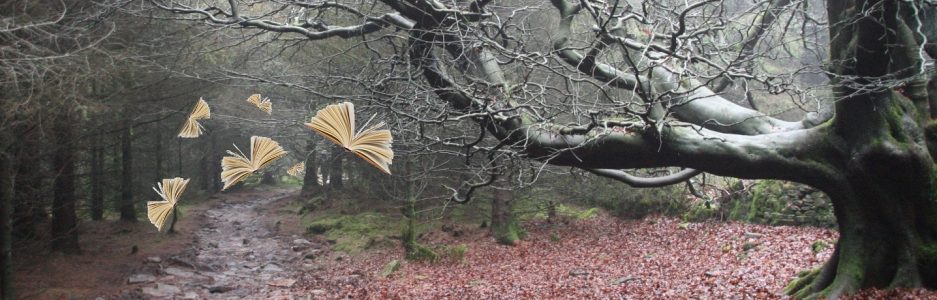
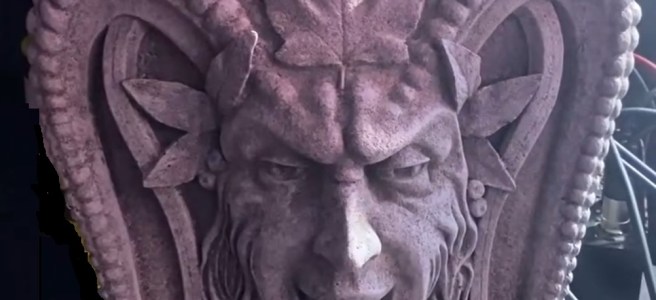
We were asked for accounts of things we had witnessed but could not explain. I haven’t shared this memory until now.
I knew him to be a Nazi. A doomed Nazi. A dead Nazi; but very much alive to me. He was also very young to be a soldier – perhaps fifteen or so – but I understood his circumstances. He was once of the Hitler Youth, promoted into the fighting infantry during the desperate days at the end of the Second World War. He had the strangest of smirks: a blend of national arrogance and terminal despondency, topped with the smugness of knowing that was already dead and that he was now haunting me. He might haunt me for a thousand years or more. Oh, and he was about eleven feet tall, with disproportionally long legs.

It was, of course, a nightmare. The first proper nightmare I’d had in many years. My horrified breathing woke me, and I felt so bad that I did not want to go back to sleep. To make matters worse, I was in an unfamiliar bedroom decorated in a Bohemian noir style with paintings of duskily contemplative crows. I couldn’t see those crows because the darkness was gunpowder black, but I knew them to be there. I wondered if they were still inside the paintings.

I didn’t share this story when asked, because dreams didn’t qualify for inclusion, and at that time the nightmare had not happened. The thing is, it happened because of that request, or at least because of the event at which the request was made. The nightmare infected me just a few hours after the performance of The Devil’s Elbow at the Golden Lion in Todmorden, Yorkshire. Furthermore, that’s where I’d seen the Nazi in the dream, in that pub, in the audience of that very show, standing alongside me.

I also saw someone else in that dream. A real person now deceased. Thirty and more years ago, when I was making small scale experimental theatre, he’d been a supporter. He served in the Preston Arts Association and gave me grants to do my distorted drama in public. He was the opposite of a Nazi, but like the Nazi, he was not really there. Sitting in the material Golden Lion earlier that night, I saw other strange apparitions that were equally real; and some were physically present. Green-toothed grannies, blooded boys, disembodied lights and boneless bodies invaded my mind. As did a swaddled musician with one skull but multiple faces. And a spectral slug.

I heard tales of people displaced from their natural time, rooms that made antagonists of the friends that entered them, a Jeep full of G.I. types and luminous enchantments on a golf green.
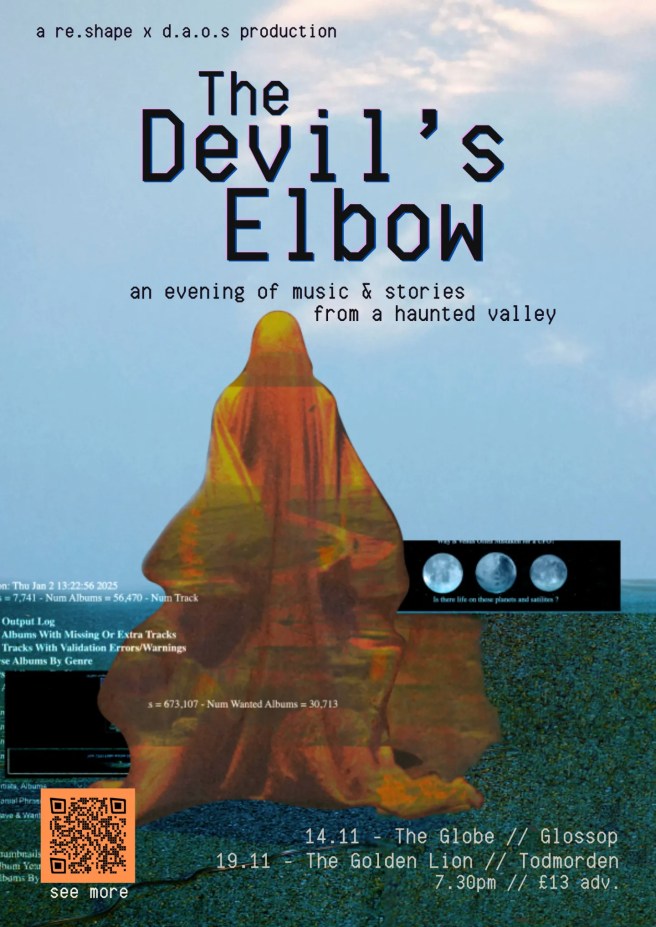
These and others were melded into an enrapturing entertainment via The Dark Art of Storytelling, and re.shape, two producers I helped produce long ago. Now they combined their full artistic might and with collaboration from fellow wizards of words and sound created a unique entertainment inspired by a notorious bend on the Woodhead Road (B6105) in Derbyshire, England. It had premiered a few days earlier in Glossop just a handful of miles from the hook of the road from which it nicked its name.

Our boys are experienced performers and have staged shows before, but this was their most ambitious joint endeavour. Theatre is a fickle paramour. It can give you the night of your life or let you down completely and publicly embarrass you. You never know how well it will go until it is gone. I’m overfamiliar with the trepidation they must have experienced as we put ourselves at their disposal.
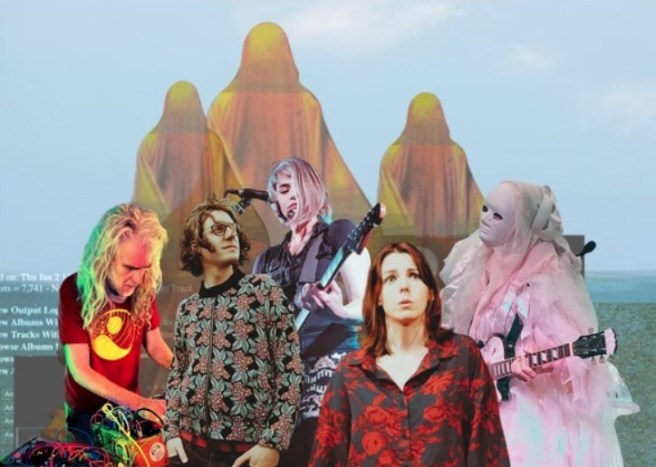
I always advocated that theatre must evolve, and so was delighted to see a fusion, the like of which I had not witnessed before. At its core was spoken word. This was not pure theatre, words were read into microphones, expressively charged with characterisation, gesture and simple adjustments in appearance. These were dramatized readings delivered amid a crucible of sensation.
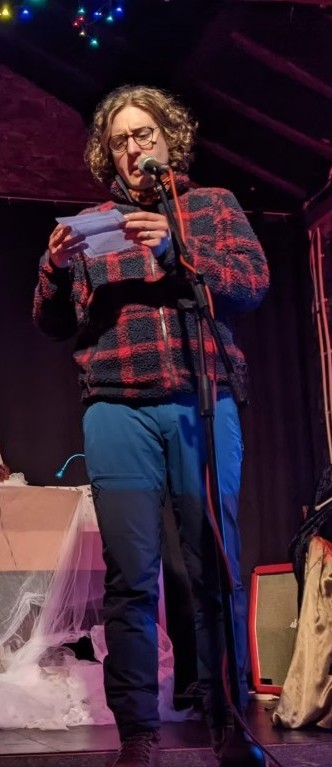
David drew together the tales he had gathered from first and second-hand sources and wove them into the spine of the show. Mixed with strands from his multi-matrixed imagination, the story of Adam and Nannie grabbed us by the crook of the arm, knocked us on the funny bone and dragged us deep into Longdendale.  David is a veteran of mentally herding audiences. He took us joyously and impishly with him, while slickly shapeshifting between multiple characters, the narrator, the mood manipulator and the master of ceremonies. His wordsmithery enticed, intrigued and amused. One wily strand tied the fiction to the fact made manifest before us.  Brothers in the Devil’s arms were also those in our eyes, and the coven of creators on the stage lived likewise in the world they jointly invoked. This, thought I, was a masterstroke I wish I’d dreamed up.

The story unfolded, gathered us in and folded up again and we were wrapped in multiple layers of stimuli.
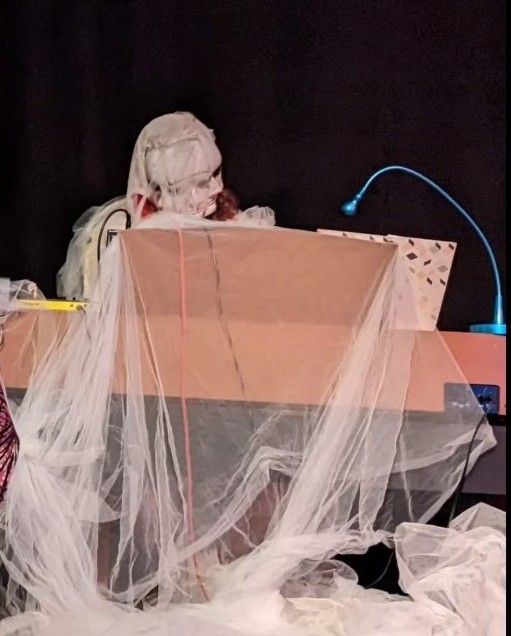
Rickerly provided the ambiguous angel wings. He manifested as a white spectre, soft and hard and comforting and menacing, as he caressed ethereal melodies from his keyboard. He entered like the grim reaper bringing and ringing out the dead. He played what might have been a bone piano as if it were All Hallows' Eve. He drew on some traditional folk tunes and served up the Devil’s own interval, forged from a trident of sharps. Like his brother, he made the ancient contemporary and the contemporary permanent by planting it in our minds. His movements haunted, his appearance unsettled, yet somehow there was benevolence there too, though it always felt risky to trust that impression.
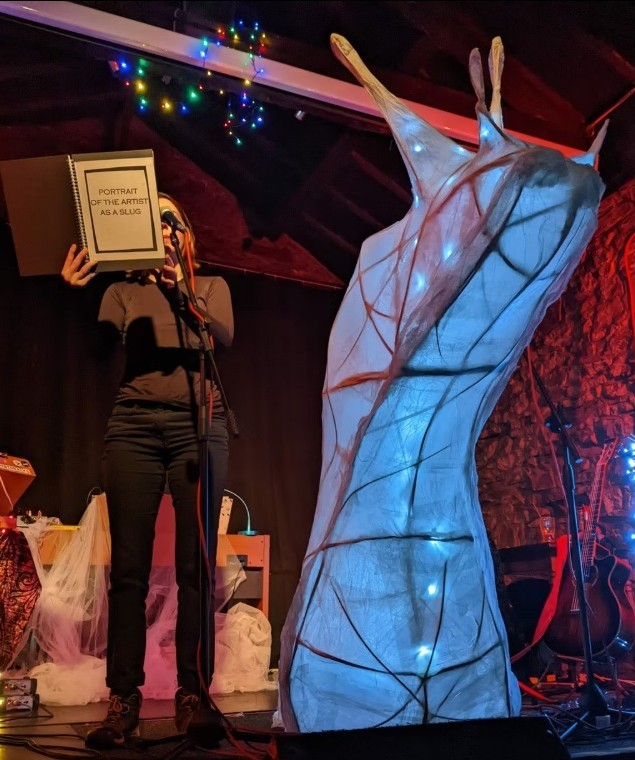
The prose and poetry and prose-poetry of Annie Acre fleshed out the fiction and added other perspectives. She extended the imaginary world whilst also anchoring it in recognisably northern roots. Her wordplay was skilful, sometimes banal, sometimes profound, and frequently unexpected. She put me in mind of poets in long-forgotten folk clubs. A knowing eye kept us intrigued, hard-voiced yet sympathetic, her manner corralled our attention. She is an other-worldly wordsmith with jars of wild-foraged vocabulary.
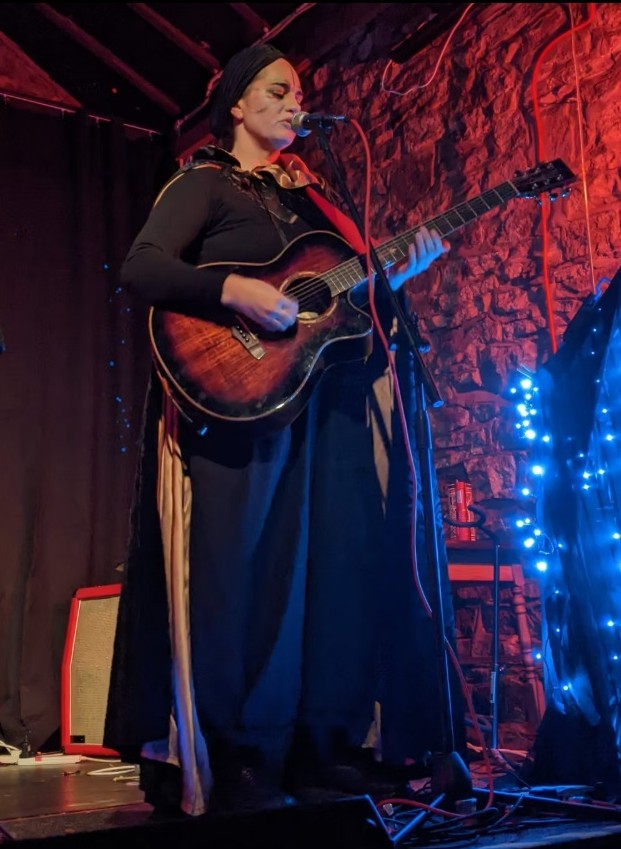
Vice Vera’s lyrics and guitar licks bolstered the atmosphere, transformed the pace and refreshed the timbre of the night. Her songs emerged from beyond the normal boundaries of the soul. They came from a deeper place as her voice abstracted into resonant presence. She appeared cloaked, and bedecked with a brandy-brown guitar from which she strummed unexpected strains. I thought I recognised the tuning and checked with her after the show. Indeed, she retunes her instrument to suit the mood, as did a favourite songwriter of mine who once sang that he thought he saw the Devil in the branches of a tree. Vera’s resonance warmed and chilled me as her sounds touched flames to the fictional frost.
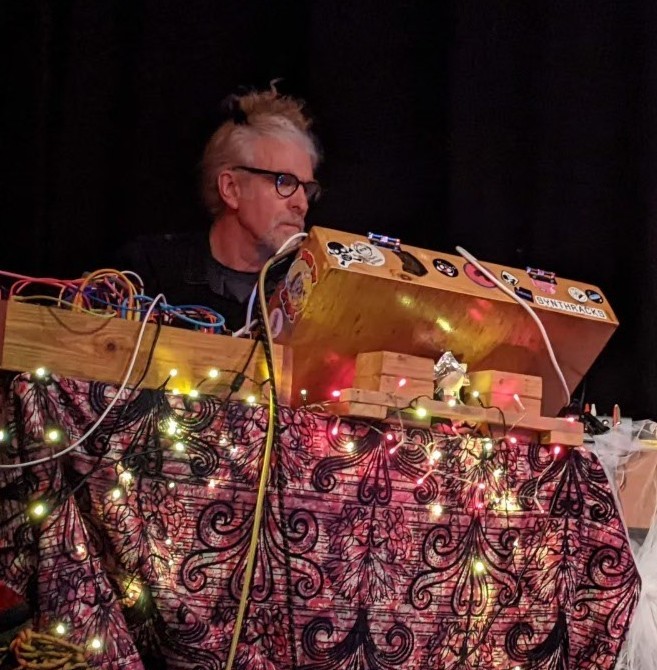
The modular synths of Heaton Norris Light Vessel Automatic created the outermost shell. His was the all-embracing audible vista, never forced or overdone, delicately balanced, fascinatingly amalgamated and, when appropriate, achingly penetrative. Mysterious sounds, some natural some summoned from the devil knows where, set the aura from the moment we stepped from the stairs and hence established this upper room as a sanctuary of something or other, but probably not for us. It unsettled as we settled and stayed throughout, even when we couldn’t hear it. It always came back, even after it had gone.
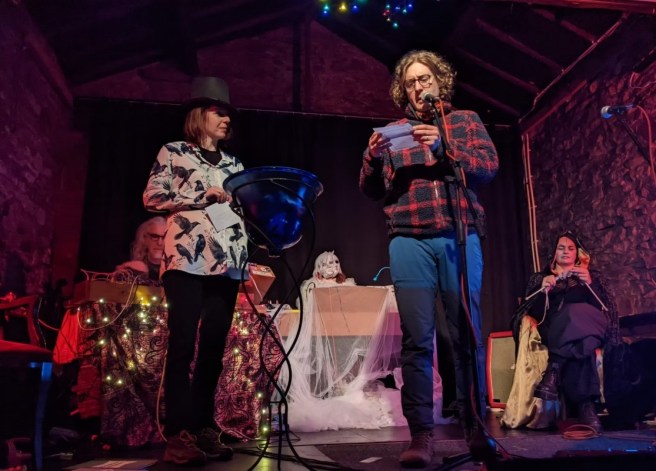
The Devil’s Elbow featured anecdotes collected that very night from the audience during the interval. It neither validated nor denied them. The object of the evening was to tell stories not to question them.

This was not pure theatre, but it was total theatre: a live crucible of stimulus in which all the component parts are fused. Total theatre cannot be ignored. I highly approved. This style of theatre is demonic. It dominates, infiltrates and re-educates. It changes your mind whether you like it or not. When you exit this kind of performance a part of it goes with you and remains forever. You cannot unsee what you have seen, unhear what you have heard or unknow what you have learned.
This production reshaped the dark art of storytelling into a unique genre without a name. My sons and their myth-smithing siblings made us see the invisible, hear the inaudible and know the unknowable. That’s what theatre should do. It is the reason it exists.
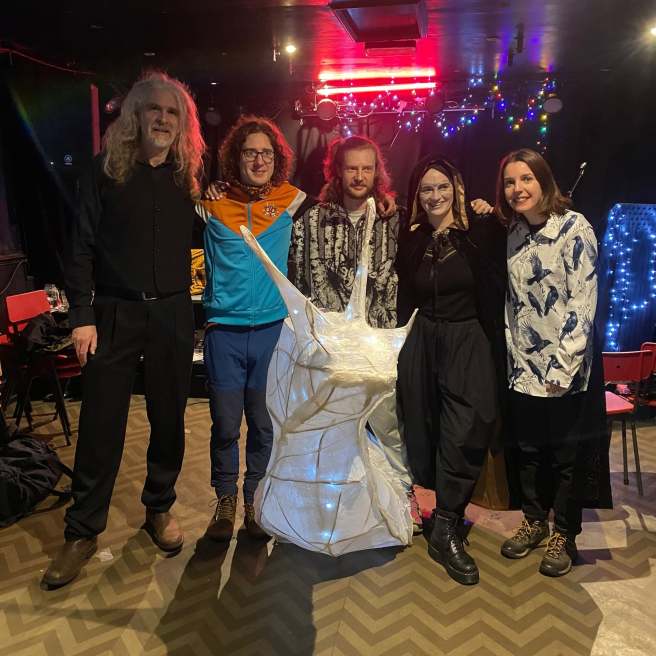
It is unsurprising that four hours later I had a diabolical dream. Why the Hitler Youth was in there, I don’t know. There were mentions of the Second World War during the performance, but they were few and not that specific. That I should dream myself back into the Golden Lion is understandable and even the appearance of dear old benevolent Bill Borrow, is not that surprising. I had been transported back to my own fringe theatre days when Bill had been so encouraging. It was not the past that enchanted me that night, but the future of the progeny that I most nurtured: original live theatre. It is in safe hands as was demonstrated by a secure arm.

The Devil’s Elbow grasped me tight.

It was demonic bliss.
Links
For more about the show and the creative team see The Devil’s Elbow Show
David’s script. The story written for the show: Boneless
The Dark Art of Storytelling’s next event will be Winter Spirits in New Mills, Derbyshire. Details from David’s website: David Hartley Writer


