

A rodent review
Agatha Christie’s The Mousetrap is the London West End’s and the world’s longest running play. Next year, on 6th October, it will reach its 75th anniversary. It was already nearly five years old when I was born. Since then, we’ve both spent a great many years in theatre, though we never straddled a stage apron until last week. My wife said she’d liked to see it. I always considered it to be not my kind of play, but I was keen to fathom the secret of its longevity. We booked tickets. Front stalls. Row D; five rows back (there was a double A row).
We did more than book tickets, we travelled a hundred miles and secured overnight accommodation. Did we enjoy it? Did I work out the secret of its long life? Was it worth it? Should you see it? I will answer all those questions, but I will not reveal the puzzle of the plot. Others have. Secrecy has died on the strands of the World Wide Web. You can find the solution very swiftly if you let the Wi-Fi do the footwork. We didn’t. I had heard a rumour. I’m always suspicious of rumour, but this one turned out to be true.
Let me say straight away that we did enjoy the performance, but I have one complaint and it is not a small one. It is something I berated my own students over endlessly. I drilled the pernicious nature of the problem into them, and sometimes, I hope, thrashed it (metaphorically) out of them. It is not a flaw that someone who has travelled one hundred miles to sit in Row D, should perceive. Perceive it I did; as did other occupants of Row D. And row E. I feared for those in Row J; and beyond.
We’ll come to that issue later, but let me emphasise that I also perceived many good things, which makes the flaw all the more irritating.
Play for today?
I do not feel that the play has survived the perspective of passing time. That is not a reason for not going to see it, on the contrary, it is one of the best reasons for doing so. This play is no longer a modern classic. It’s just a classic. It is a very good example of the way the so called ‘well-made’ play used to be made. (Mostly plot and little emphasis on anything else.) The set depicts the correct original period and is constructed in pretty much the same way though perhaps using more modern materials and methods.
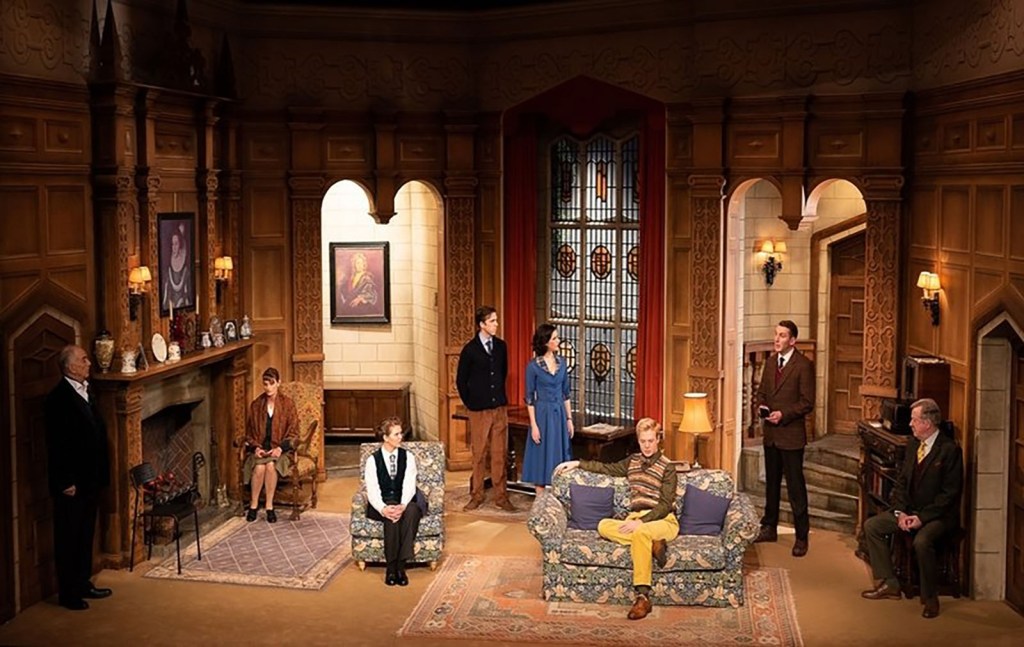
The cast appear authentically garbed and move in ways people used to move in 1952 – if they were on stage. In fact, some of the cast were especially adept at this, which for me added to the pleasure to be had from the show. They knew their job was to incriminate their characters if they were innocent or sanitise them if they were guilty whilst also bluffing that they might be bluffing. It’s a game of catch me-if-you-can before we prove you wrong. This is the interaction the audience expect from comedy crime. This cast played a well-paced game in the right spirit. In my amateur theatre enriched youth, such dramas were everywhere; now they are virtually extinct.
I don’t think the audience in 1952 had lower expectations, but they had experienced a narrower range of crime fiction than is force-fed to us today. Although the plot of The Mousetrap is credible enough and functions suitably for the story, you will have seen or read crime fiction that is constructed with much greater complexity and unravelled with more creativity. The key breakthrough in this tale is not discovered, it is revealed. If this were a new script, revisions would be demanded.

The Mousetrap was adapted from a radio play called Three Blind Mice. They had to change the name because there already was a stage play with that title. The play was written, and last week was performed, as a light comedy, in fact, almost a farce. It is, however, based on a true backstory, which is far from funny. That did jar for me slightly, but the majority of the audience didn’t seem to mind.
The story does satisfy, in as much as any sanitised plot-based crime puzzle satisfies. There is a crime that has taken place just before the play begins, but that is not the one that most troubles the characters. Another happens before your very eyes, though you will not see it clearly enough to know the perpetrator. After that we are in full whodunnit mode, with almost everyone a suspect and hence almost everyone a herring ruddy in complexion. All will be revealed and you are given almost enough information to solve it. Add a little lateral thinking and you might get there before your peers do.

Today we call this type of fiction ‘cosy crime’ not a term Agatha Christie would have bandied about, even though she purveyed more illegal inglenooks than anyone else. Chocolate box crime demands that a company stage something blatantly artificial. People do not really behave with tongue-in-cheek detachment if someone has actually been slaughtered. Consequently, the cast must play ciphers rather than characters, and they did this well enough
Here’s the cast that we saw:
Cast
- Emily Laing as Mollie Ralston. Mollie is the hostess of a newly opened small hotel, formerly a Manor House. Laing was impressive. She had a very light but deft affectation. Hence Mollie appeared not as a real person, but as a real person would have been portrayed on stage in 1952 in a play of this nature.
- Jack Hardwick as Giles Ralston. Married to Mollie for precisely one year following a three-week courtship, Hardwick made much of standing in alcoves with pocketed hands, as people in mid-twentieth century dramas often did.
- Thomas Barrett as Christopher Wren. Wren is a tank-topped over-the-top refugee from a Famous Five world somewhere in the mists of middle-class fancies. This type of character was a mainstay of mid-century matinees. They were given ridiculous eccentricities for no other reason than to make spectators whoop with laughter the way they used to in theatres in the days before the whoop became surrogate applause. Plus, if they’re funny, they can’t be killers – can they?
- Clare Duffy as Miss Casewell. Duffy gave one of the best performances. Social progress has made the part resonantly modern. In its day this would have been a nudge-and-wink curiosity. Casewell chooses a strongly androgenous appearance and Duffy carried this off with an enigmatic attitude that made me care less about her role in the crime puzzle and more about the state of mind of the character behind the caricature. Clever; on several levels.
- James Peake as Mr Paravicini. This is not an easy part to be given for multiple reasons. Alongside ‘Christopher Wren’, Paravicini was put in here to make the audience chuckles drown out the boiled sweet wrappers. He was the ‘let’s make fun of a foreigner’ device. Paravicini is an overblown European excentric indicative of ice-cream or insurance TV adverts of much more recent times. This does not help. Paravicini is “a man who wears make-up” according to his fellow suspects, especially when they are in the spotlight of scrutiny. The suggestion is that he is not what he appears to be. He is the clearest signal that we should never mind the murder and just enjoy the mirth.
- Alfie Richards as Detective Sergeant Trotter. A part originally played by one Richard Attenborough. Trotter is given a comedic carapace by arriving at the snowed-in hotel on skis. His levity is seldom lowered, even when things get serious. Richards flits about with a smidgeon of camp as he conducts the obligatory pencil-and-notepad flutter. There was not much else a detective need do in those days.
- Nicholas Bailey as Major Metcalf. Landed gentry with military history were common as muck in mid-century casts. Tweeds and waistcoats and aerated vowels are all that is required. The audience knew what to expect from those roles, which is precisely why Christie put this one in. Bailey gave us a blunderbuss of pomposity. There is no alternative.
- Susan Penhaligon as Mrs Boyle. And so, we arrive at the matriarch of stock characters. An elderly single woman, opinionated, critical and loud-mouthed. Which is precisely how Penhaligon played her. Thank goodness.
As soon as the first two characters entered dialogue my heart raised. They were not miked. This is authentic theatre. Then nine years of retirement slipped away, and my hand began twitching towards the non-existent notepad of my drama-teaching days. I could hear the cast well enough – but only just well enough – and I was in row D. What about those behind me? And above me; and above them? More characters arrived. I began to miss the odd word here and there. I reflected that it was probably time I booked that hearing test. Then Susan Penhaligon entered and the problem exited; at least while she was speaking.
During the interval an elderly woman to our left was attended by a theatre technician who examined her hearing aids and tried something with a smartphone. I spoke to the lady and her companions after the show. Her difficulty had not been resolved. She had not been able to follow the dialogue.
My wife told me that she had overheard someone behind us commenting that she was catching “most of it”. That had been my experience. I did enjoy the play, but £57 to hear most of it, seems a particularly cosy kind of crime.

The problem
My critical notepad, had I had one, would have had PROJECTION and DICTION scrawled over it as it often did in days gone by. Unfortunately, these are no longer essential requirements of the acting profession. Most actors earn what they can from screen work. The microphone is close at hand, or even nearer. Most stage shows are completely miked these days. It’s essential in shows with amplified music but I don’t like it, because all the voices come from the same direction and are delivered at the same volume. It is preferable to not hearing the words, however.
Modern actors no longer need the skills to reach across sixty yards of flip-up furnishings. By chance, one of the companions of the lady next to us was a recently trained graduate of one of the well-known London Drama schools. I asked her if she had been trained in projection. She avoided the question but said she was often told to project more. That is like telling a non-swimmer to swim.
The solution
There is nothing here that could not be resolved by an hour in the company of a good vocal coach to remind – or perhaps teach for the first time – the basic breath and voice techniques that every stage actor knew how to employ when this play was first performed.

The conclusion
Why did The Mousetrap become the longest continuously running stage play of all? Now that I’ve seen it, I think the answer is simple. It became the longest running because it became the longest running. In other words, its longevity is perpetuated because that in itself is the reason for its fame. It originally gained that accolade at the Ambassadors Theatre, one of the smallest West End venues, which aided its exclusivity and thus helped it to run and run.
It is not a bad play, but neither is it especially good. There are comedies that are funnier and thrillers that are more thrilling. There are cosy crime capers that are cosier and more criminal. There are thousands of plays that are more meaningful. The only reason to see this play is in order to see this play. If you do I hope that you also hear it – fully. Perhaps book a seat in row B.
The company that we saw gave us an enjoyable evening. They put on the play we wanted to see with the upbeat efficiency we expected. The set looked splendid and the characters collectively showed us whodunnit. Susan Penhaligon, however, showed us how it should be done.
The performance we saw was at The Alexandra Theatre, Birmingham on the evening of 8th September 2026. This was the start of the 75th Anniversary tour. Adjustments to the production may have been made since then.
The Mousetrap is still at the St Martin’s Theatre in London: London Mousetrap
Meanwhile, the show we saw is on the run: Mousetrap UK & Ireland tour
Similar posts
For an example of a contrasting show see: Peter Pandered
Help with doing it yourself:
Find out more: https://www.amazon.co.uk/Drama-What-how-Pete-Hartley/dp/B0B49JP892


