The unspoken garden was Scottish long before it was rooted in Lancashire. So claimed the author Nigel Tranter in his 1979 novel Margaret the Queen which I purchased close to that time but have only just got round to reading. The central character, Maldred MacMelmore of Atholl, reports to king Malcolm III (slayer of the infamous Macbeth) that his lands ‘are secure to Lancaster and the Ribble’. I live just two miles north of the River Ribble. Hence in the eleventh century, long before Lancashire was generated, the land that contains the unspoken garden was governed from Dunfirmline in Scotland.

That assumption depends on the veracity of Tranter’s research, but a cursory investigation suggests that Malcolm and his liegemen did make numerous excursions south. Cumbria was governed by him and the ‘fluid’ boundaries of the times indicated that the county of wonderful lakes may have extended as far as my maternal river.
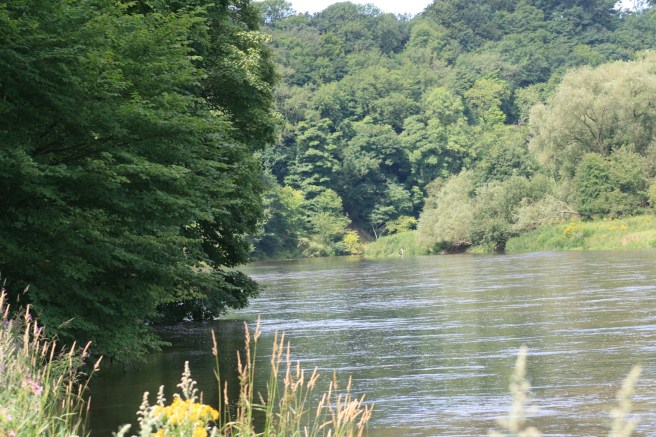
The River Ribble
My reverie into the fictionalised brawling and bawling of medieval Britain was interrupted by the even more insistent bellow of Trumpet the Tit. This tiny songbird has a vocal capacity that is inversely proportional to his diminutive build. Boy, can he belt it out, and he has been doing so relentlessly this spring. My Book of British Birds, which is even older than the Tranter novel, tells me that Great Tits sing to establish their territory even before they start nest building. We do not know if Trumpet is one of the pair of Great Tits that have bred in our laurel-hedge hidden bird box for the last two summers. He could be, or he might even be one of their offspring that the secret gardener saw fledge twelve months ago. He likes the sound of his own voice even more than some narcissistic American leaders.

Careful observation revealed that Trumpet had adopted a birdbox that I moved last winter from an Elder tree at the foot of the garden to a Leyland Cypress close to its centre.
Trumpet’s tower is the conifer column close to the top of the steps.
Another voice disturbed me in the garden. Whilst tinkering with a tiny train in the Bani-shed a programme came on the radio about faith and personal fortune. In an episode of Heart and Soul a woman told of how she had answered the call laced with blissful promises and joined Isis, an action she later rescinded and now regrets. Several times during the broadcast she spoke about her fear of ‘going to Hell’.  That fear had been used as part of her recruitment but later became a factor in her reversion away from extremism. Several aspects of her story saddened me, but the one that pierced the deepest was how such a rational, intelligent and articulate person of 2026 can still harbour a concept as groundless as the notion of a place of perpetual afterlife torture. I really wanted to speak to her and tell her that regardless of the mistakes she claims to have made, she will not go to Hell. No one will. Hell is not there. We cannot go there, though we can deliver it to others.

As always, I shared my musings with the unspoken garden.
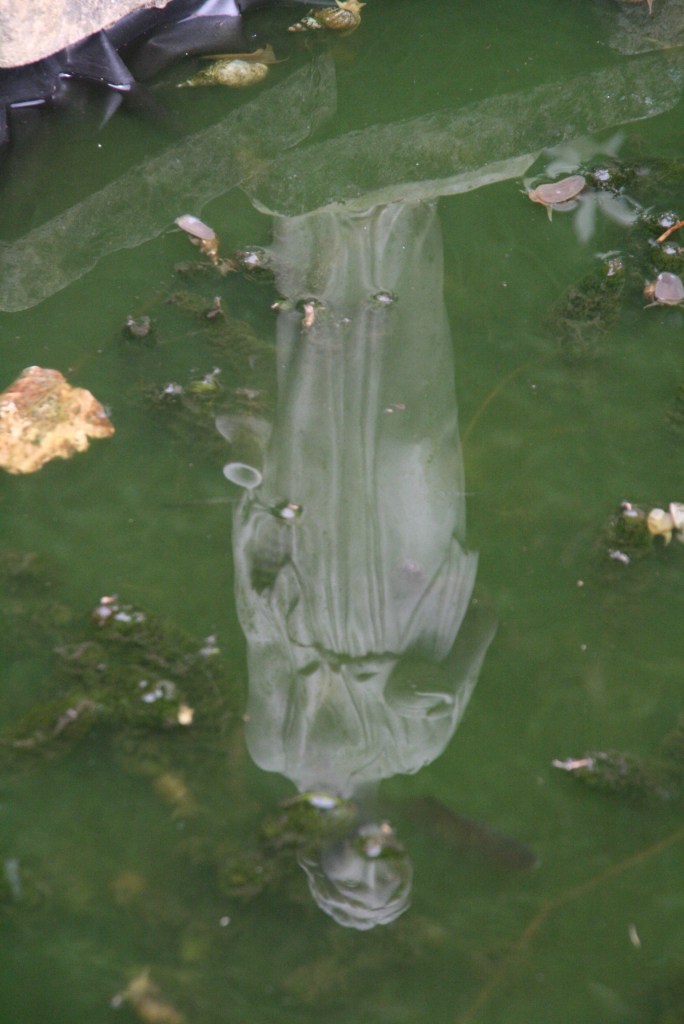
The pond reflected.

Trumpet the Tit paid no attention.

The collared dove clergy of the unspoken garden shook their heads. They are sacred scholars but deny any knowledge of Heaven or Hell. For them our garden is Eden. It is also a place of perpetual peril. Cats prowl. Buzzards survey. Humans cannot be trusted. Pray be mindful, say the dog-collard doves; or be prey.

For Trumpet, this place cannot be named and claimed by any human; it is tit land. He’s gone a little quieter in recent days but now carols can be heard from a tiny choir in the Leylandii loft. The secret gardener can hear them, though they are too high for my old ears. Trumpet and his partner are far too busy to spend hours proclaiming their territorial claims; they have mouths to plug. One bugbearing visit every three minutes was noted at my lunchtime observation. Live – breed – feed - repeat. It is the only mantra needed.

The thing about Trumpet is that he is mostly bravado. Yes, he will brawl with interlopers and repel them from his patch, but as far as I can tell, he doesn't go into the garden of number 13 and wreck other birds' nests. He doesn't destroy threats at a distance at the behest of a Coal Tit. He doesn't seek to make other homelands his. He defends and nourishes his brood, that's all.

Trumpet has stopped drawing attention to himself. He sneaks from branch to bough before diving into the living camouflage where his afterlife is swelling towards fledging.
This could be Trumpet, or his partner, or his parent, or none of the above. Picture taken last year.
We are afterlife. We are the resurrected substance of our forebears. We are the living dead of all we consume.

The unspoken garden is not Scotland, or England, or Cumbria or Lancashire. It is land. Land only belongs to land. It was here before humans gave it names, and it will be here after they have all gone to ground. Meanwhile, it’s Hell or Heaven, depending on what we make of it.

The unspoken garden speaks. Stop shouting; keep feeding, it says.

Keep breeding.

Or as we, generations ago, in our fledgling days, used to say: make love, not war.
Former drama teacher, fringe theatre producer and director, and author of novels, short stories and some non-fiction work. I now hawk my output under the moniker of uneasybooks.
View all posts by Pete Hartley