Five decades digging under the wood ‘whose every tree-foot’s cloven’
I was something of a wimp at high school. To avoid the rough tumbles and chilly breezes of the playground I volunteered to help in the library. Not all the attractions there were literary. There was also a trio of enigmatic female volunteer librarians, one of whom still chooses to share covers with me five and a half decades later. We didn’t become bonded until our sixth form years, which is when I also began a long-term love affair with sixty-three Welsh people frequently found in libraries.

Prior to those Welsh encounters, back in 1970, whilst in what we then called ‘third year’ but is now known as 'year nine', I was among a group of library refugees given the task of inserting printed cards into the brand-new books designated as Prize Day prizes. To my astonishment I suddenly found myself holding a card bearing my own name and the words Drama Trophy. I was also particularly pleased when the prize turned out to be an actual trophy, a small statuette which remained on my parents’ mantelpiece for three years, because the drama teacher had retired and no-one thought to award it again or ask for it back.

Preston ran an educational regime comprising separate schools and sixth forms. The exceptions to this were the independent schools, and those establishments provided an alternative to the municipal sixth form.  For Catholic pupils this meant us being intravenously inserted into a grammar school that until that point, we had been deemed too unfortunate to attend.  My Catholic contemporaries and I were thereby channelled out of our co-educational classes into single-sex sixth forms, which I regarded as a discriminatory diversion. We were presented with a choice of grammar schools: one for boys and two for girls. I applied to all three.

I was only admitted to the boys’ school where same-sex classes were something of a hormonal disappointment or delight, depending on one’s personal predilection. Sadly, I fell into the former category. There was, however, a chink in the penitential curtain. The alleged celibates were undergoing an enforced enlightenment and experimenting with replicating real life in their consecrated conclaves of indoctrination. Certain lessons could allow boys from the Jesuit fortress to mingle with girls from the convent school next door. These were strictly non-examination courses. One of which was drama.

I was studying sciences and mathematics but in keeping with one of the finer grammar school traditions, Wednesday afternoons were given over to sports, or more wimpish diversions such as chess, classical music appreciation, stamp swapping and drama. The latter was held in the semi-subterranean steam-pipe heated gymnasium of the convent school. The anticipated warmth was too enticing to resist.

In those halcyon times, punctuality was non-negotiable for pupils and entirely optional for staff. Our designated mistress, whose name I am unable to recall, was invariably twenty to thirty minutes late, an indisputable symptom of being unwilling and unprepared, but to her credit, once there she gave a good performance, which is always reassuring for a drama class. She seemed to take a benevolent interest in the spiderly aspiring scientist who claimed to have held a drama trophy hostage for three years. She entered us for something called The English Speaking Board Qualification. One component required us to stage an extract from a play. She cast me as Mr Pugh in Under Milk Wood by Dylan Thomas.  In my then unimagined subsequent career as a teacher of drama, I would later produce that play more than any other. I adore it even almost a decade into my retirement.  Why? Permit me to begin, once more, at the beginning.
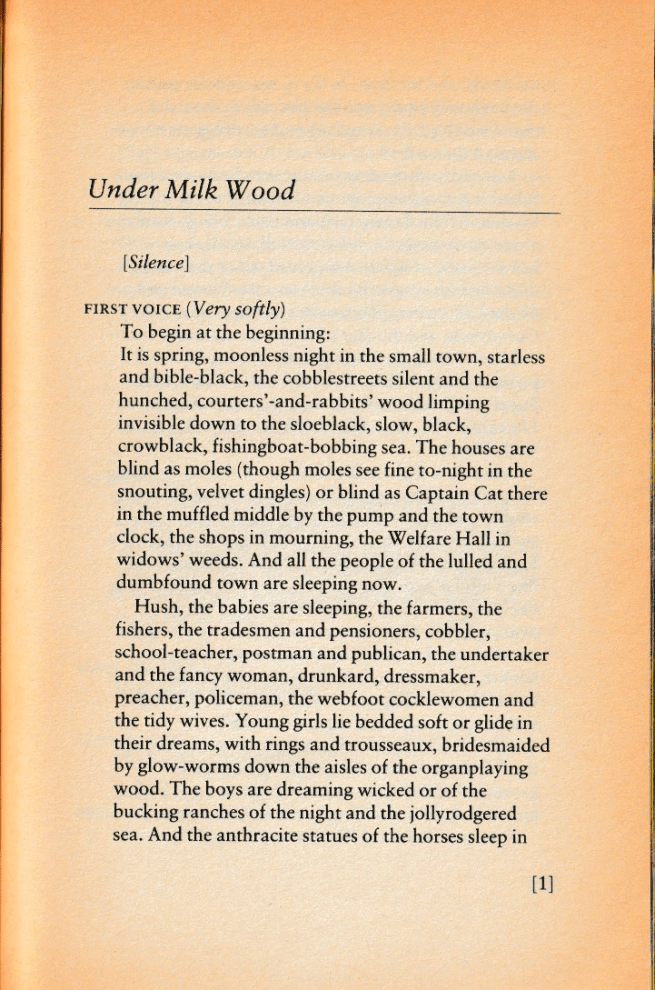
This ‘prose with blood pressure’ was written gradually over several years by the Welsh poet Dylan Thomas. It is ‘a play for voices’ and was first broadcast on the radio by the BBC on 25th January 1954, two and a half years before I was born.

Set entirely in the fictional village of Llareggub, or more precisely in the minds of the villagers, it does not mention telephones, televisions or radios (or wirelesses as my parents invariably called ours). There is no talk of trains or aeroplanes and barely a mention of motor vehicles. All those things were commonplace by the 1950s, though villages like Llareggub were still being spared the technological excesses that were swamping towns and cities. The only communication is via the human voice and the written word. The play is, therefore, a period drama of great purity. This is one of the reasons it has great value today. This play for voices is all about the things people say when technology can’t get in the way.

It is a play without a plot. There is no central story. Instead, there are sixty-three perspectives, one for each speaking part, and the structure relies on the ancient unity of time: the events commence and conclude within a single day.

It is not a perfect play. Dylan Thomas admitted it was unbalanced. The opening monologue describes the pre-dawn on page one of my much-thumbed 1985 edition, and ‘the morning school is over’ sixty pages later, but the afternoon, evening and night are all crammed into just thirty more pages. Thomas did write more material for the latter half but not in time for the deadline he’d been given. He met his own premature terminal deadline two months before the premier broadcast. The incomplete play is therefore the final edition.
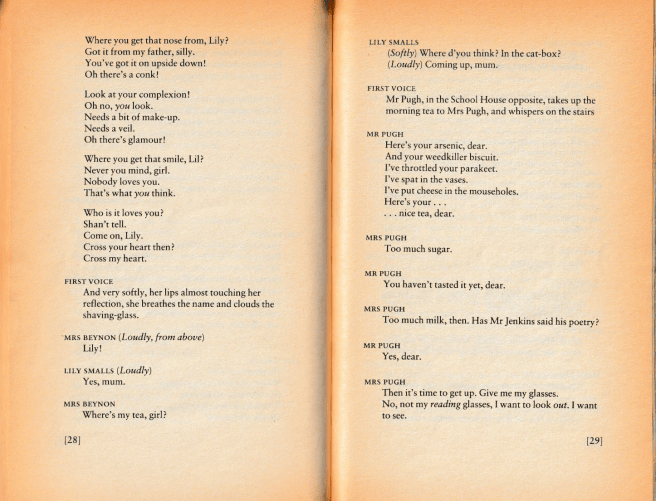
The science-studying wimp, unsurprisingly, failed to become a fighter pilot, but ended up instead as something much more satisfying: a drama teacher. I produced full versions of Under Milk Wood three times, but I staged extracts from it more numerously than I can recall, often as exam pieces. It is very useful teaching material. There was always some initial resistance because of the perceived need for Welsh accents, but they are not essential. If you listen to the original broadcast, you will find the authentic cast’s accents vary from profound to non-existent. It is more important for the performers to seek out the natural rhythm and musicality of the vocabulary and syntax. Today it is much easier than in my heyday to listen on demand to Welsh voices and appreciate the lilt and emphasis they apply.

The play is a richly fertile resource for several reasons. Because it is a radio script it has maximum flexibility when staged. Apart from a few sound effects, there are no stage directions. Everything is described or implied by the dialogue. The characters – or caricatures – are old and young, living and dead, alive and imagined and most rarely for a play from this and all other prior periods: male and female in almost equal quantities. There are thirty female-designated roles plus three gender-neutral narrators, and the nature of the play is such that it readily facilitates gender-blind casting.

What about its suitability for a multi-cultural cast? Despite being perhaps the best-known play to emerge from Wales it is not a work about being Welsh. It is a study of individuality amidst a community. See below with respect to its theme of humanity.

Directors do not need a cast of sixty. Most appearances are brief and doubling is usual though you have to check to ensure doubled characters do not appear in the same sequence, unless you are employing a very flexible style. It can be presented highly entertainingly by just a handful of physically expressive performers. I have seen this play impressively performed by a single actor.

The First Voice and Second Voice roles are large. I found it useful to slice those parts up and distribute them among the cast. The script also accommodates singers. Polly Garter and Mr Waldo have songs and there are choral sequences too.

So much for the practicalities, but what about the most crucial question: why bother?
The language
I fiercely reject the academic grafting of drama to literature. They are totally different genres, but the beauty of Under Milk Wood is that the literature becomes the drama. The characters embody their own descriptions.
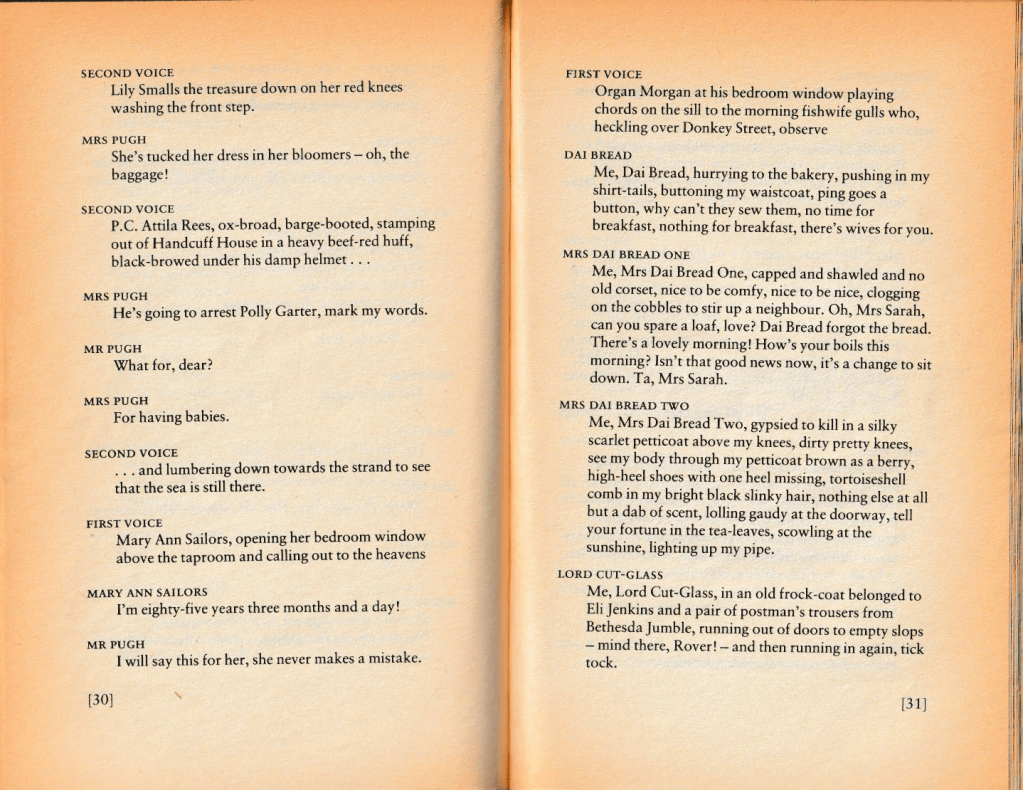
There is a real joy in hearing the poetic prose being spoken and in seeing it extended physically. The language is much richer than that usually found in contemporary drama, hence it allows for a more flamboyant style of acting, all of which adds to the surreal quality of the piece. The cinematic versions of this play do not work as well as live productions do because they are too realistic.

The humanity
Under Milk Wood is a period piece and therefore of its time. The people are identified by their occupations and marital status, and that may jar millennials and gen z players, but is important to see beyond that. The female roles are strong, in fact, they mostly dominate despite the subservience expected of them. There is also a preponderance of what we might today identify as neurodivergence. There are many obsessives and eccentricity is so prevalent as to be the norm. The veil of conventionality is frequently lifted to expose behaviour that secretly goes against the grain. This is a play about difference and attitudes towards it.

The humour
The initial popularity of this play lay with its serious humour. Time passes but people essentially stay the same. Our world has changed significantly over the last seventy years but audiences still recognise the truths that belie the falsehoods, and in Under Milk Wood that revelation comes primarily via the humour. Postal workers may not steam open our mail, but if they deliver it, they know who is corresponding with us. Today we all suffer from electronic delivery systems that know precisely what we read. Gossiping neighbours in Under Milk Wood share their opinions over the garden fence, in modern life they share them over the internet. The play shows that those gossips have their own secrets and that those who judge are not immune to judgement. Time and again we see arrogance undermined, bigotry exposed and pretentiousness belittled. That makes us feel so good that we laugh.

The natural
Thomas has provided a work of imagination, but it is all rooted in observation. If you observe humans carefully what you will always detect is that which we so often go to great lengths to disguise: our nature. We can dress ourselves however we choose, but underneath is the human animal. We may be shocked when Mae Rose Cottage peels off her pink-and-white skin in a furnace, in a tower, in a wood, to wait there raw as an onion – but that’s what Thomas does to all the characters in this earthy exposé. The coverings and layers are pulled back until we can see the stinging reality of their true inner nature. We are all onions.

We are planted, we grow, we decline and ultimately decompose. We all have our day in the sun, before the eternal night returns. Then it all begins again.
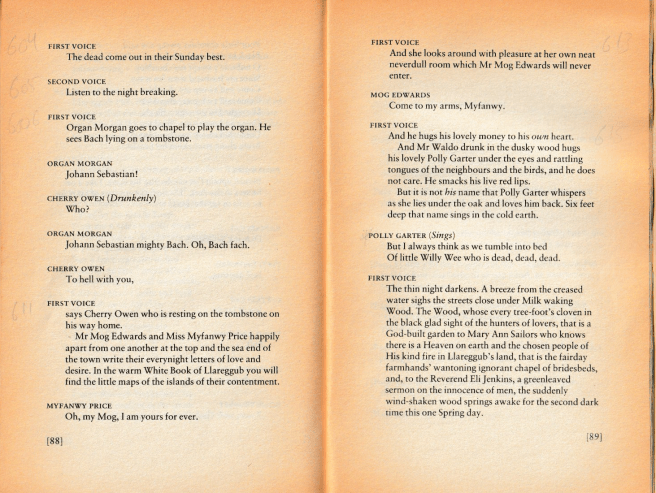
Milk Wood is a devilishly magical place. The feet of the trees are cloven, but that is entirely natural.
Fortunes and timetables
That day in the library in 1970 foretold my future, though I couldn’t see it at the time. Strapped into the sciences in the sixth form, the memory of the trophy and patronage of the benefactor led me to select drama as my mid-week recreation. That in turn took me to Under Milk Wood.

One Wednesday afternoon the sixth form drama class was bundled into a coach and trundled along the Fylde Coast to a hotel where teachers were holding a conference. We provided the entertainment during the coffee break. Mr Pugh’s weedkiller biscuit speech went down well.

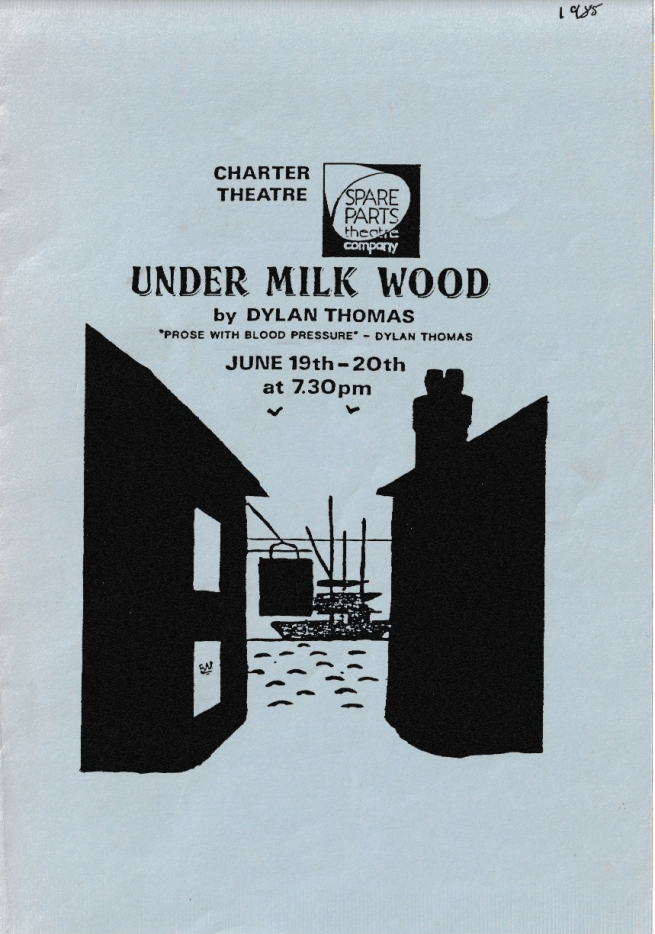
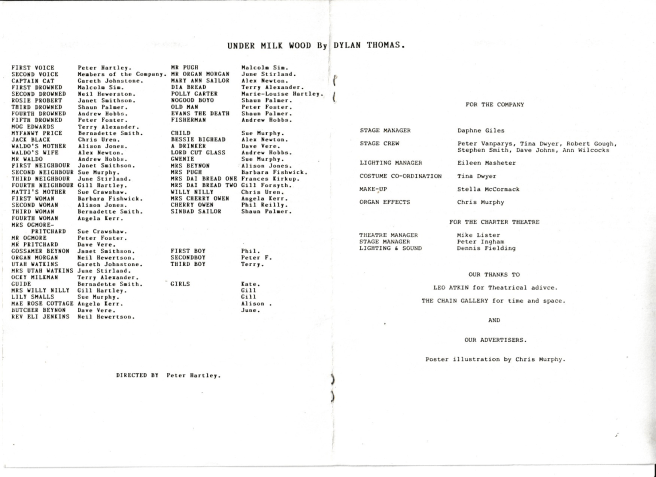
On the way home the drama teacher invited me to go along and join the local group of which she was part. I declined. I was already a member of the drama group that had been formed by the retired teacher who had bestowed the trophy, and which also counted a certain volunteer librarian amongst its members. That group never produced Under Milk Wood. Neither did the group to which we later defected. The group after that was the first theatre company I formed. For our initial production, I ensured that we began, at the beginning.
References and further reading
Pictured extracts from: Everyman Classics Under Milk Wood ISBN 0 460 11006 3
For more on drama see: What’s the Drama?
For more on drama v literature see: Reading without the room
What happened next and how you can build on it
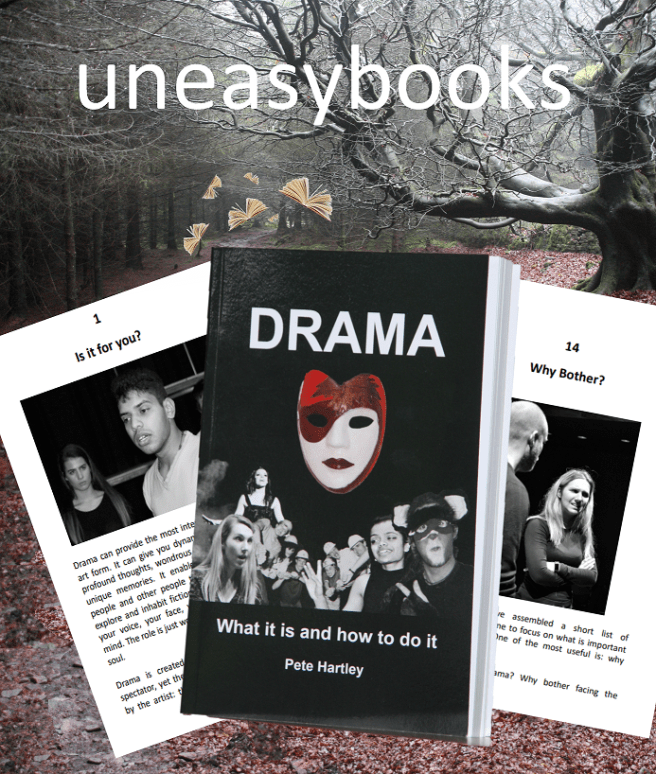
Thirty years of experience for you to use: Drama: what it is and how to do it

 uneasywords