
If you write ghost stories you must be prepared for the inevitable question: do you believe in ghosts? When I first made a collection of my Christmas ghost stories, I answered that by saying that I didn’t believe in ghosts but was frequently haunted. I maintain that attitude. Why then do I continue to write ghost stories? Well, there are several answers to that.
While I might not believe in ghosts, I don’t doubt that some of those who claim to have seen a ghost are being honest. This is something explored in my Modern Gothic story Livid. It’s all a matter of perception. What we see sometimes does not correlate with what others around us may see. We see with our brains, not our eyes. Including when we are asleep.
The theatre director Peter Brook said something very interesting about ghosts when he was discussing the motivations of Hamlet. He said that you don’t need to believe in ghosts to see one. If you see a ghost, then at that moment, you believe in it. This is irrespective of whether or not the ghost is actually there. Of course, he is absolutely right. If you see a ghost, it doesn’t matter whether the ghost is in your bedroom or just in your head. The physical, psychological and emotional consequences will be the same.
Another response to the inevitable belief question is to reply by asking the inquisitor if they think Tolkien believed in hobbits. When compiling literature we are relating a fictional world. Hobbits, elves, aliens, ghosts, vampires etc, etc, are ciphers. They are components. It is not necessary to think they actually exist in order to use them in fiction. In fact, no fictional characters actually exist. If they did, they would not be fictional.
When the question of believing in ghosts arose at one of the Modern Gothic launch events, I replied first by suggesting it wasn’t the most pertinent enquiry on the topic. Perhaps the most apposite query is to ask why aren’t all ghosts naked? Where do they get their clothes from? If polyester has an afterlife we have a much bigger plastic problem than we thought.
So, no I don’t believe in ghosts, but I do think that the experience of being haunted is of vital importance, and so I keep being drawn back to ghost stories. Ghosts, hobbits and aliens are very much present on pages, and it is from there that they may have something vitally important to say.
That is why, having sold all my initial print run of my Christmas ghost story anthology, I have chosen to re-issue it as another charitable edition. This version has nine stories – two more than the previous imprint. Here is a little information about each of them:
TO WHOM IT MAY CONCERN
This story was first published in the Lancashire Post on Saturday 17th December 2011.
This was written to help promote the initial eBook version of this collection. It draws on a number of traditional myths associated with my home city.

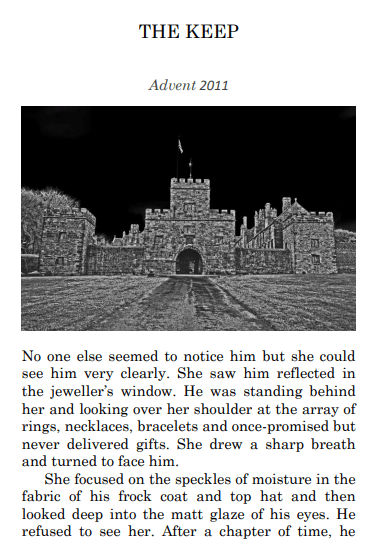
THE KEEP
This story was written in 2011 in response to reading of Charles Dicken’s visit to Hoghton Tower in 1867 and his short story George Silverman's Explanation published the following year.
Charles Dickens visited Preston on more than one occasion. His visit in 1853 is thought to have provided much of the inspiration for his Hard Times novel, but a later visit to Lancashire included an exploration of Hoghton Tower midway between Preston and Blackburn. The tower at that time was not in the best condition. That trip informed one of his lesser-known shorter works: George Silverman’s Explanation. In 2010 my fringe theatre group had taken a very successful show, Will at the Tower (later reworked into a novel), to Hoghton and subsequently there was some discussion about returning with a play documenting the whole history of the tower. Unfortunately, that project never came to fruition, but this story emerged during some of the research while I was considering how the narrative might be brought to life.

A number of years later, the foundations of the keep in question were excavated, (see Finders Keepers] and I went along to finally see some of it with my own eyes. Prior to that I had only seen it in my imagination.
PILLION
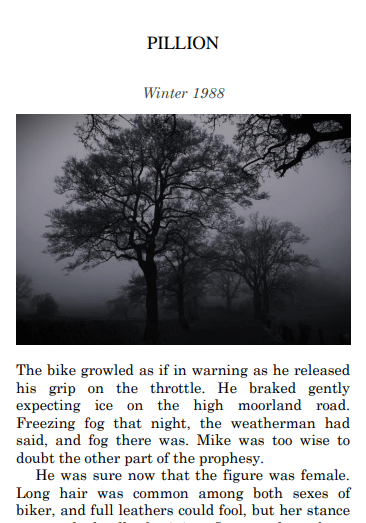
This story was written for radio. It was broadcast on BBC radio in North West England in the winter of 1988.
I had two motorcycles as a teenager. The first was a rather ineffectual mule known as a Yamaha 80, but that was replaced by a much-loved Honda CB125. This story, inspired by negotiating icy patches while motorcycling through the Trough of Bowland, was written a decade later in response to a submission request by BBC Radio Merseyside.
WAITING AT THE DRAY-HORSE INN
This story was first published in Lancashire Life magazine in December 1982.
The editor of the Lancashire Life magazine was the first person to pay me in order to put my work into print. The publication purchased a poem in the mid-1970s and then carried a series of four Christmas Ghost stories, starting with this one in the winter of 1982. The magazine still appears monthly today, and does not substantially differ from its style forty years ago. Then, as now, it was mostly aimed at the comfortable aspirational, but in the 70s and 80s there was also a tacit embracing of lovers of the county who might not necessarily be able to afford the jewellery, lingerie, high-end cars, antiques and classic furnishings that filled the features and advertisements. The readership therefore, was broader than might be presumed at first flick.

It was not a periodical frequently found on my parents’ coffee table. In fact, I don’t remember us having a coffee table. We had an enamelled tinplate tea tray with legs that folded out and pinged into place when visitors called. Infrequently they might have spotted a Lancashire Life among the Reader's Digest, Woman, Woman’s Own, Victor, Beano and Radio Times pile on the sideboard. Some of our extended family were more la-di-dah, as my mother might have said, and on visits to their homes I had become aware of the kind of material that found its way into that publication.

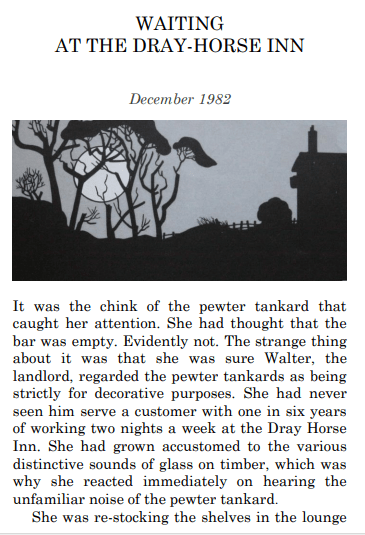
This tale was inspired by something I saw in the snug bar of the New Drop Inn on Longridge Fell. It was late one winter evening and the popular pub was emptying but there was a lone drinker deep in thought in one corner. He had longish hair, wore an old coaching style overcoat and held a pewter tankard, so he looked strangely out of time. It set my imagination racing.

The story seems a little dated now, but I was thrilled to bits on the November day in 1982 when I walked into the WH Smith store, picked up the mag, found page 58, and hurried from the shelf to the counter to hand over 70p.
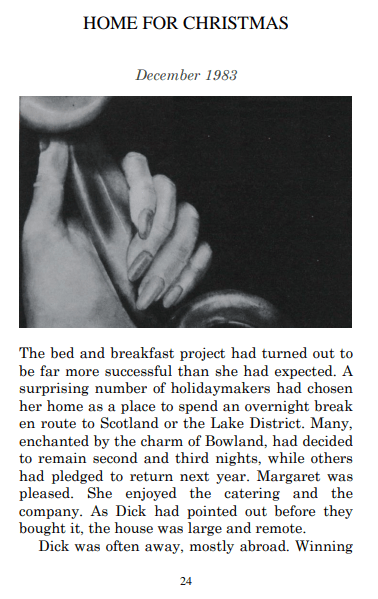
HOME FOR CHRISTMAS
This story was first published in Lancashire Life magazine in December 1983.
The second in a series is always tricky, and I was not confident that the editor would bite again but William Amos, was happy enough. This one had a different feel to it. The rural isolation played its part, but the sinister has a twist that suits the season.
THE COMPANION
This story was first published in Lancashire Life magazine in December 1984.
Despite verging on the twee, this has always been my favourite from the LL cohort. It was triggered by a winter walk over the Bleasdale Fells when a sudden blizzard completely obliterated the landscape and I lost my bearings. Fortunately, the weather improved, or the story might never have been written.

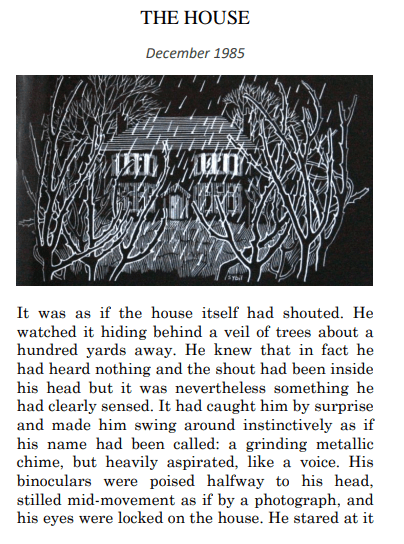
THE HOUSE
This story was first published in Lancashire Life magazine in December 1985.
We moved house, and this was the first Christmas story written in our new abode and the last to appear in the Lancashire Life magazine. Our home is nothing like the one in the story, except that we chose our new residence because of its generous back garden. We have completely revamped it, but when we first came here there was a vicious rose bed that had been somewhat neglected. Its appearance after dark was positively demonic, and frequently reminded me of a haunting song by my favourite group (see earlier post: Gloomth and the Six Pillars of (Modern) Gothic). A lyric is: Twisted branches catch the eye. This found its way into the story:

As he freed himself from the rosebush, another hand poked its stiletto fingernail at his eye…
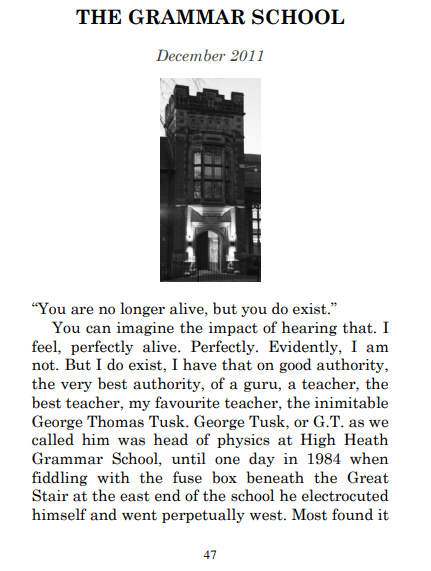
THE GRAMMAR SCHOOL
This story, written in 2011, was inspired by a number of Preston grammar schools. The characters were drawn from memory, imagination and indoctrination.
Upon assembling a compendium of ghost stories, I decided that a much longer tale was needed to make purchasing the volume more worthwhile. I also wanted to enjoy writing a ghost story that was longer than those required by my previous markets. This is the longest ghost story I have written – though it is only marginally longer than Livid, in Modern Gothic. I’m very fond of this tale.

The reasons for my joy begin with the title. As soon as the story started to take shape, I spotted the full potential of the title. It enabled me to establish a new grammar of haunting, and while doing so to educate the protagonist in that topic. That was a very satisfying process.

The first line was lifted from the aforementioned Mr Dickens, who starts the mother and father of all Christmas ghost stories, A Christmas Carol with:

Marley was dead: to begin with.

I thought that sentence could have even more impact if it were transferred from the third person to the second and directed at the first. If the narrator begins by being told that he is no longer alive not only does that deliver a killing blow, it establishes a long-living question: how can he experience what he is experiencing, and can he survive it?
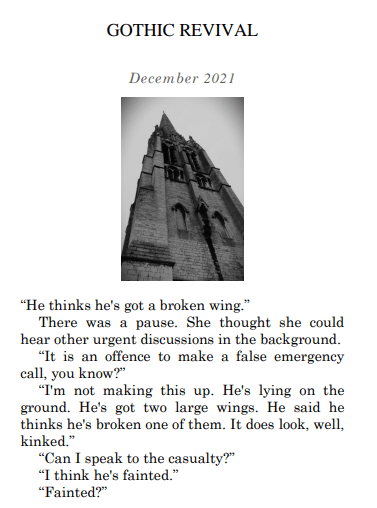
GOTHIC REVIVAL
This story was first published in the Lancashire Post on 27th November 2021.
This was written two years before I was prompted to write a new Gothic tale for the recent Fly on the Wall anthology. This somewhat light-hearted story was suggested by the architectural label and the magnificent example of the same that graces the Preston skyline. (Keep your eyes peeled for it if you are travelling by train.) Designed by Joseph Hansom (who designed the original Hansom cab), it boasted the third tallest spire (after Salisbury and Norwich cathedrals) in the country. Each spring that spire becomes a premium nesting site for peregrine falcons. You can see and hear them. With a snippet of imagination, they could be soaring and falling angels. The rest, is this story.
Why ghosts at Christmas?
At a recent Christmas market, one of my customers asked why ghost stories are popular at Yuletide. Dickens must take some of the credit, but I suspect that the tradition of the telling of supernatural tales is a very longstanding one for this season in the northern hemisphere. Nights are long, often bitterly cold, and often accompanied by the associated mists and chills and haunting calls of night creatures. The festivities themselves, irrespective of their specific religious origins, are habitually illustrated by supernatural narratives. The natural and the cultural put us in mind of the mysterious. Atmosphere is the best midwife of the fantastic.
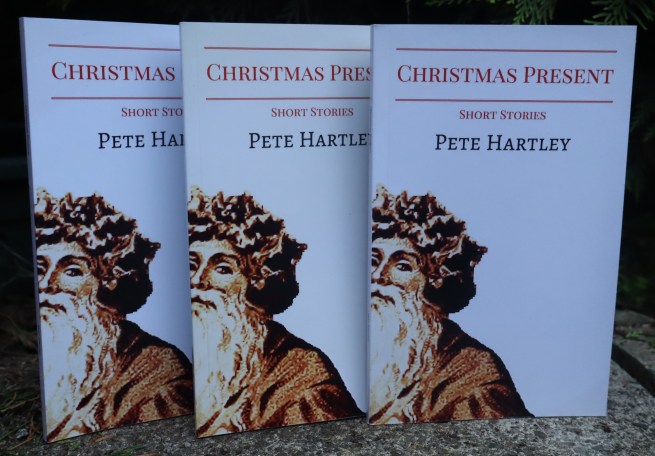
This collection represents a key component of my development as a scribbler. The earliest examples gave me validation and remuneration at a time when both of those things were craved. My needs are not the same these days. The only desire now, is to entertain, and to encourage others to do the same.
Those in need of more essential nourishment are always there, but we are reminded to share at this time of year, and I’m very happy for these stories to prod me to do that.
All proceeds from this publication in 2024, will go to my local branch of Cancer Help.
You can buy it here, or here…


 uneasywords