

A review of the Mikron theatre production at Hesketh Bank, 28th September 2024
One of the few benefits of the Covid pandemic of 2020 was to remind us of the artificiality of educational ‘excellence’. For a brief period, it was a little easier to secure a place at a university. Surprise, surprise, educational progression is so much more possible if the barriers are lowered. Please do not detect cynicism here. My degree was attained with the Open University, for which the educational entry requirements were zero. Quite right too. If that were not the case, it would not be truly open. One of the founders of the OU was Labour MP, and Minister for Education, Jennie Lee, about whom I knew very little until two hours of theatre last Saturday taught me a great deal, and did so in a magnificently effective manner.

The truth is that ‘under-achievement’ is frequently not a factor of poor potential or of lack of effort but of barriers put in place by those wishing to preserve the exclusivity of their own experience. Jennie Lee (Janet Lee 1904 – 1988) had the determination and tenacity to bash through whatever was placed in her way, and then kick open more gaps for others to exploit.

The daughter of a coal miner, Jennie found inspiration in the local bookshop, and her parents were supportive enough to let her take up a university place, something that few working-class women could contemplate in 1920s Britain. Jennie didn’t stop there. She marched into politics and into the House of Commons, becoming the youngest MP at the age of 24 which meant that, due to sexist ignorance, she was six years too young to vote in an election. When she later lost her seat, she took up journalism and reported from civil-war torn Spain.  She married fellow socialist Nye Bevan (who would later found the NHS) and was re-elected in the 1945 General Election. In Harold Wilson’s 1960s parliament she was one of the main driving forces of the ‘university of the air’ which became the Open University an organisation devoted to providing gainful knowledge for all.

Mikron (pronounced ‘mee-kron’) theatre has similar aims. This company takes theatre to places where other shows don’t go, and hence delivers that sometimes excruciatingly elitist art form into the midst of those who may not feel inclined, or able, to venture into the environs where it is more usually found. They’ll get to you by road, or by narrowboat (on which the cast often reside) and deliver their output with exceptionally high green credentials. They charge their own stage lighting batteries from the motor that propels them along the canal network. They also charge affordable entrance fees. My ticket was £14. The performance was superior to many for which I have paid very much more than that.
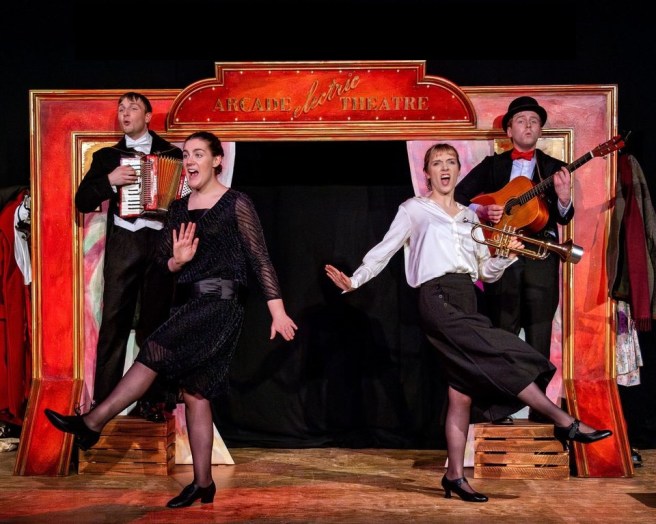
Their style is that designated in the 1960s as ‘Rough Theatre’ – i.e. rough and ready theatre. Despite that designation, this method of presentation with simple authentically approximate props, quick-change costume, and minimal scenery can be - and was on this occasion - just as polished and just as moving, as the technological, gargantuan beast to be found in purpose-built performance spaces.

Mikron were excellent. The cast of Eddie Ahrens, Mark Emmons, Georgina Liley and Lauren Robinson, were slick, efficient and thoroughly competent. Their acting was pragmatically tuned to the needs of the space and the spectators. Their vocal skills, so often lacking in modern live performance, were robust, crisp and powerfully projected. Each one is an accomplished instrumentalist and their singing was always delightful and at times, such as with the four-handed harmony that launched the second act, was simply exquisite. “Wow!” was the quiet exclamation from one appreciative listener seated not far from me.

I feared, to begin with, that they might be in outdoor mode, with their voices a tad over-projected but they soon modulated to a more comfortable delivery for our cosy modern enclosure. Similarly, I feared Lindsay Rodden’s compact, witty, enlightening and emotionally nuanced script was over using the “I’m playing this part…” exposition in the initial set-up but that too, quickly dissipated and the transitions between roles and locations swept along smoothly. It was then that the real depths of the script and the suitably enhanced underplaying, especially by Lauren Robinson in the eponymous role, brought out the emotional depths of the peaks and troughs of Lee’s life. We saw the ambition, the no-nonsense determination, the parliamentary bravery, but also the discretion, the hidden appetites and the trauma of loss.

All four players were superb. Their flexibility and integration realised a fully dovetailed presentation and each had personal highlights that drew warm reaction. Georgina Liley’s Margaret Thatcher cameo provoked bitter-sweet guffaws while my personal peak of joy was found in the three-minute caricature by Messrs Ahrens and Emmons of early 1970s Open University TV lecturers with their clip-on kipper ties and goggle-eyed exuberance.

This was a never-need-to-look-at-your-watch type show. It moved at a brisk pace and contained sufficient contrast to ward off any spores of boredom. The script, the music, and the sheer shared joy of traditional storytelling jogged along cheerily. Now and then, there were times to pause, to reflect, to inspire. It was a mind-opening script, and that, of course, was the point. Jennie Lee opened minds, not just those not normally admitted to universities, but also the minds of others like herself, who refused to have doors slammed shut in their ‘unfitting’ faces.

Marianne McNamara’s direction wisely kept the stage picture moving, with frequent use of simple soapbox platforms to pop the actors’ faces much higher than the heads of the audience, and to maintain a vertical variety in the staging. I would have liked more of the stylised movement of the kind employed during the hunger marches song, but I was never not entertained.

My one chief concern lay not on the stage, but in the auditorium of the lovely community centre at Hesketh Bank. The house was full, but almost devoid of those younger than the Open University, which was born in 1969.  Theatre will never die, but it must not ignore the symptoms of something that could deprive some potential participants. Jennie Lee was a champion of universal access to the Arts and Mikron are a fine example of how a live shared experience can educate and enrich. I fear that the cash-sucking extravaganzas may out-compete the grass roots travelling player produce, of which Mikron is such a worthy exponent. I’m sure they’ll play to more age-diverse crowds elsewhere, but they, and theatre as whole, must somehow continue to smash through the smart screen glass cages that could keep young eyes from the joy, knowledge and inspiration that live theatre is uniquely capable of making open to all.

Jennie Lee took education into the air, Mikron bring it back down to earth, and that, at the end of the working day, is where it is most beneficial.
For more about my experience of the Open University see: I.O.U.O.U.
For more mind-opening thoughts on theatre, you might enjoy:
Or for a historical fictional insight into rough theatre:
Click on the pics to discover more

 uneasywords
One thought on “How Jennie Lee opened the door for you and me”