
Grasping the Gothic part two: out of the shadows
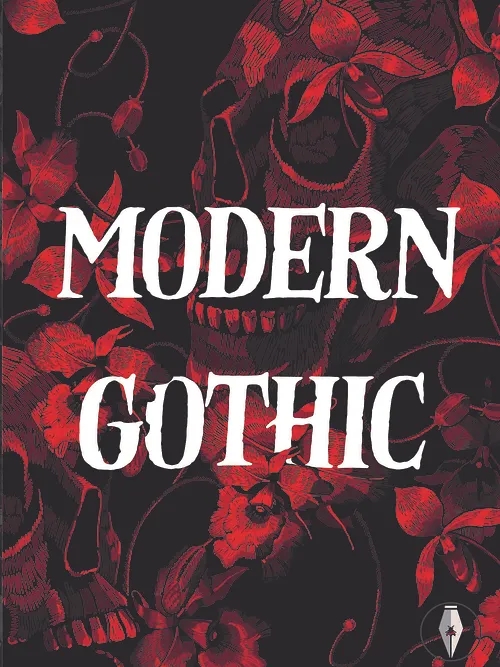
Ahead of the publication of Modern Gothic an eerie anthology from Fly on the Wall Press uneasywords is exploring the Gothic genre, its origins, influences and development.
Seems Madam? Nay, it is: I know not seems
There is no doubt, in my mind that Hamlet, is a Gothic work. Plays of the sixteenth and early seventeenth centuries (Hamlet was written between 1599 and 1602) are rarely, and only retrospectively, classified as Gothic, though this play, along with several others from the Elizabethan / Jacobean period, is unquestionably so. It has all the key elements: haunting – both real and psychological, grotesque artefacts, a labyrinthine environment, dysfunctional domesticity, a relentless pre-determined plot, a reclamation of the present by the past, and – most typically of all – an overarching vault of ominous gloom. This does not seem to be a Gothic work, nay, it is.
Seemes Madam? Nay, it is: I know not Seemes:
‘Tis not alone my Inky Cloake (good Mother)
Nor Customary suits of solemne Blacke,
Nor windy suspirations of forc’d breath,
No, nor the fruitfull River in the Eye,
Nor the dejected haviour of the Visage,
Together with all Formes, Moods, shewes of Grief,
That can denote me truly. These indeed Seeme,
For they are actions that a man might play:
But I have that Within, which passeth show;
These, but the Trappings, and the Suites of woe.

(Hamlet. Act I Scene 2)
The above is an excerpt supplied by the Original Shakespeare Company in 1990. The spellings, grammar and layout replicate those found in the first Folio of 1623. For an authentic delivery, say the text out loud putting additional stress on the words that begin with a capital letter.
Tis not alone my inky cloak, good mother,
The Gothic label originally suggested a rebuttal of classical influences in favour of supernatural nature. Hamlet typifies this. It ignores the classical three unities of a single unbroken timespan, a single location, and a single plot, and presents, instead, an episodic structure that has action in several settings in and around the Danish castle of Elsinore, and is multi-stranded in its storytelling.

It draws surely, on Shakespeare’s personal experience. ‘Hamlet’ is only one twenty-sixth of the alphabet away from ‘Hamnet’ the name of the eleven-year-old child that the playwright had lost in 1596, and the play is laden with familial reflections regarding parents and children. Scholars often dismiss the connection, as the Hamlet story was already well-known before William applied his quill to it, but choices of topics are just as subject to emotional influences as are themes and characters. Hamnet was named after a friend of Shakespeare, the baker Hamnet Sadler, who sometimes signed his name Hamlet.
Shakespeare’s father died in 1601, and it is impossible to imagine that the Bard’s bereavement as both father and son would not have influenced his poetry touching on such a relationship. His father was penalised for not attending approved church services and there is evidence that he may have been a closet Catholic. A Catholic heritage is something that the Bard may have been careful to keep hidden as first Queen Elizabeth, and then King James, prosecuted their anti-popery agendas. The Ghost’s lines are considered among the most Catholic of those contained in Shakespeare’s plays, and it is the role with which he is most associated as an actor. The Ghost, of course, is Hamlet’s recently murdered father.
The playwright was well into his fourth decade by the time the play was written, and living amid a society in which he was just about hitting the average life expectancy age. While that statistic was skewed by a high infant mortality rate, he would be more than aware of the fragility of human existence when disease, poverty, poison, accidents and violence were ever-present and immediate threats. Death was never far away. In Hamlet it is always close at hand. In Gothic tales it is seldom absent.
Nor customary suits of solemn black,
Hamlet, as a tale, had a common origin with the historic sources of Gothic as a noun, emerging, it seems, from a Scandinavian yarn. (See the previous post in this series: Sharpening the curve) It must be noted, however, that the core ‘foolish-hero’ theme is found in the traditions of many cultures. This, however, only serves to reinforce its Gothic label, for it pins the tale quite firmly to the grotesquely beautiful notion of madness being a kind of wisdom.
Nor windy suspiration of forced breath,
Gothic makes us gasp, not in an affectatious way as suggested by the above sub-heading, but from genuine shock. Hamlet has those in abundance; though, of course, all theatrical affects are created by fakery. In addition to the appearance of the aforementioned ghost:
So shall you hear
Of carnal, bloody, and unnatural acts,
Of accidental judgments, casual slaughters,
Of deaths put on by cunning and forced cause,
And, in this upshot, purposes mistook
Fall’n on th’ inventors’ heads.
All this can I truly deliver.

(V.2.374)
Says Horatio, Hamlet’s best pal. Horatio sees the ghost of Hamlet senior, and witnesses some of the more grotesque moments, for example, when the skull of Yorick is exhumed by a gravedigger and affectionately handled by Hamlet junior.
No, nor the fruitful river in the eye,
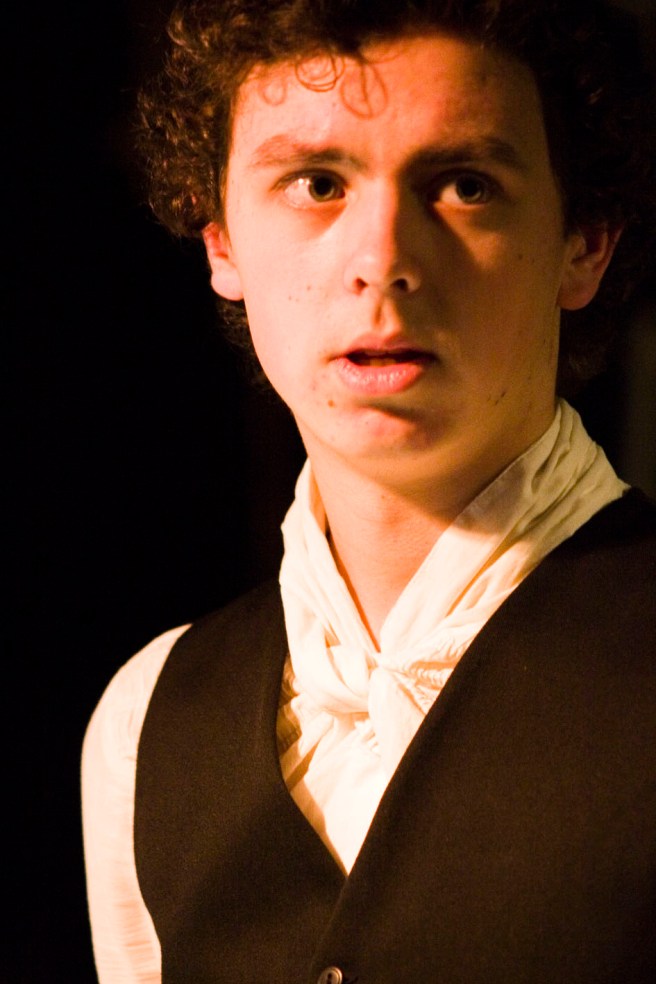
Hamlet’s sometime girlfriend, Ophelia, presages the melancholy heroines of many a subsequent Gothic story. Driven to distraction, to tears, and eventually to first a watery, and then an earthy grave, she embodies the tragedy of those collaterally damaged by Gothic plots. Her love is rebutted, her appeal for an explanation is cruelly deflected, and her father is accidentally slaughtered by her boyfriend who will subsequently, and melodramatically, declare his devotion to her corpse whilst within her grave. Thus, we have one of the finest features of the Gothic format – action that is over-the-top but is somehow brought back down to earth by the gutsy grappling irons of the genre. We expect the Gothic to be melodramatic. Act five does not disappoint.

The final fifth of the play contains an unintentional exhumation of an old friend, an interrupted funeral, a grave violation, a rigged sword fight, a poisoned chalice, four violent deaths, a Norwegian invasion led by a son in revenge of a slaughtered father, and a bromantic exchange of last words. In Gothic style all it lacks is a soundtrack by Meatloaf; and that can be arranged.
Eat your staked heart out Dracula: Hamlet is more Gothic than a cobwebbed candelabra in a mist-laden, ivy-riddled, bat-infested cemetery.
Nor the dejected ‘havior of the visage,
Together with all forms, moods, shapes of grief,
That can denote me truly.
Hamlet is surely the most introspective of all Shakespeare’s characters. He has his witty moments, but his soliloquies are universally sombre, even if they end upbeat: “Wherein I’ll catch the conscience of the King”. (II.2 603) Setting his humorous interludes aside, he does indeed embody all the forms, moods and shapes of grief, and the loss he feels is not just that of his deceased father but of the purity he ascribed to his mother, the contentment he once held and the inheritance he presumed to be his. He also loses his girlfriend, his innocence (killing both deliberately and by accident) and his life. “Oh, what a rogue and peasant slave am I.” (II.2 547) he declares. Thus, he casts the mould for subsequent Gothic protagonists – wrapped in angst inflicted on them by prior events. Gothic is the past proverbially claiming the present; and the future.
These indeed “seem,”
For they are actions that a man might play.
According to Jeffery Singman, in 1600AD some seven out of ten men and nine out of ten women in England were illiterate.[1] The Gothic novel was still a century and a half away, but drama brought the genre to the masses in the outdoor early modern theatres such as The Globe. Furthermore, with the development of indoor playhouses, the mood, and spectacle of the spectral story would be even more immersive, though the poorest playgoers would find it harder to find the entrance fee. The point is, though, that Hamlet and the like would establish the Gothic adventure in the minds’ eye of the fiction lover. It was a major influence on Horace Walpole, a fundamental figure in the Gothic Revival movement and in the founding of the Gothic novel as we will see in a future post.
Madness to the Tudors was seen as more comical than we regard it today. Hamlet’s ‘antic disposition’ would be more amusing to them than to us, whether or not they considered it actual or faked, but in either case it does not lessen the tragedy of the mental degeneration of the hero. He is so fixated on his revenge that, regardless of whether his madness is real or fabricated, he is beside himself and knows it. The late director Peter Brook, selected a much-overlooked phrase spoken by the Ghost when he is asking for revenge, as the key to the play:
But howsoever thou pursuest this act
Taint not thy mind

(I.5 84)
This task is impossible, says Brook, for such a moralist as Hamlet cannot kill without compromising his principles. The whole of the play is the exposition of a severely tainted mind. Hamlet is the embodiment of a ruined church. He is page one Gothic.
But I have that within which passeth show,
These but the trappings and the suits of woe.
Elizabethan drama gave Gothic fiction its glorious debut. Due to budgetary and scheduling limitations companies such as The King’s Men were not big on scenery. Apart from a few stock items (e.g. the somewhat ‘rotten’ chair of state (throne), beds, tables, barrels, sacks etc.) the background would have been left to the imagination of the spectator, and the Elsinore the Elizabethans would visualise would be Gothic. The haunted battlements, the shady castle chambers and gloomy closets, and the chapel wherein Hamlet cannot kill his stepfather because he is at prayer and hence his soul might go straight to heaven, all summon up Gothic environments. They are the background against which the relentless descent to the inevitable reckoning, as decreed by supernatural forces, is played out.

“Nothing is what it seems in the theatre,” says the protagonist of ‘Livid’ in Modern Gothic, “not even the truth.” This is true. “Theatre is life lived without pretence,” said Antonin Artaud, French actor and director and father of the Theatre of Cruelty. This is also true. The lies of the theatre are the true revelations of the lies in life.
Hamlet exposes the progeny of the past. The legitimacy of the living is the legacy of the dead. We belong to what has gone before; and it is coming after us.
Notes and references
[1] Singman J L, Daily Life in Elizabethan England, Greenwood Press, 1995 p 42
The first full quotation by The Original Shakespeare Company The Tragedie of Hamlet 1990. All other text references from The New Penguin Hamlet 1980
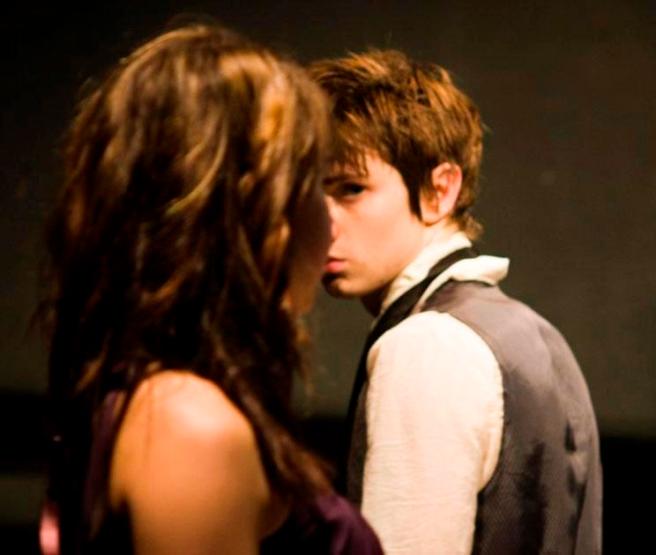
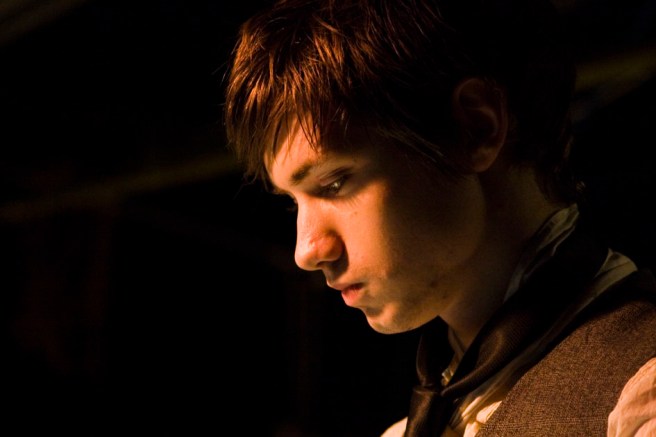
Photographs by Tobias Rose of Hamlet in a Nutshell, the 20th Anniversary production of Cardinal Newman Limelights Theatre Company, staged at Lark Hill, Preston, Lancashire in 2007.
Pictured cast:
Hamlet: Andy Jones
Horatio: Joe McCrave
Ophelia: Sara Wilson
Claudius: Pete Hartley
The theatrical is the spine of all of the stories in the forthcoming Modern Gothic anthology. The tensions between the characters expose the deterioration of their souls. The protagonists endure hauntings both ethereal and psychological. They wrestle with moral validity set against pragmatic reality and played out in the face of public propriety. Edward Karshner’s Dark Water entangles the natural and supernatural, the biblical and the biological in murky machinations. There is a supreme dialogue with the unseen in Rose Biggin’s A Respectable Tenancy which provides a most peculiar relentlessly haunting experience at an excruciating cost. All the tales have inky cloaks. The ink is red.
Related posts


 uneasywords