And be ready to reject the A.I.ble
I recently visited an art exhibition that both pleased and disturbed me. It was a room of old photographs of my home city. Some of them, originally monochrome, had been artificially colourised. There was also a video display in which those same pictures were then animated. At first I found it fascinating, but then I felt betrayed.
I’d previously seen similar animations online. It takes powerful artificial intelligence and, according to the artist, considerable time. I’ve always been an appreciator of artistic endeavour, so why was this unsettling for me? It’s a question of truth.
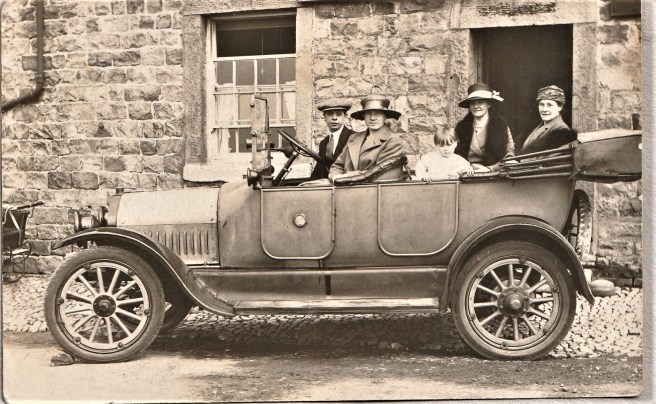
A black-and white photograph is not entirely truthful. It obscures a major component of the original subject: colour. In form, and visual composition it is accurate and true. In those terms it shows what the camera saw. If we add colour artificially, it can feel as if we are adding truth, and if the colours have been expertly researched, that might be the case, but we can’t be fully confident. What about any individual variations, adjustments or accidents?
Consider a common topic: military scenes. We may have extant examples of uniforms from the period, but there is no guarantee that the example in the picture was by the same manufacturer or had not changed in part due to wear and tear. Pedantic perhaps, but possibly important to an historian. The problem is more significant with everyday clothes. Without firm evidence, the colours are guesses. You might feel such presumptions are unimportant. Would you feel the same about skin tone?
So much for coloration, but what about animation?
It is really fascinating to see a frozen scene from the Edwardian era suddenly filled with movement. After a while though, it begins to become a little grotesque. The people in the movie almost certainly did not move in that way. It is captivating, but the more they move the further they are from the truth the picture purports to portray. This does not mean that the video is not a work of art, but it has transitioned from truth to lies.
How would you feel if one of the animated people began to attack a child? What if the attacker, or the child, was an ancestor of yours? What if the photo was contemporary and the aggressor was you? Thanks to AI, it is extremely likely that this kind of abomination will proliferate.
Could such a video be counted as art?
Literally fake
By definition, all of fiction is a lie. We can argue that all art is lies. Those lies can reveal deeper truths. That process is compromised though, if a particular truth is being implied while a different reality is being depicted.
Then there is the bigger AI lie: that the art is purely the product of human imagination and endeavour.
Does it really matter if the fiction you enjoy was written in part, or in whole, by an artificial author? Probably not. We all watch movies, listen to music and eat food, that has been prepared by a combination of the natural, the mechanical and the digital. We may grow to prefer that which eschews the modern and reverts to the traditional, but we still succumb to the synthetic in times of weakness or for convenience. When it comes to art and literature, it is more difficult to detect the ingredients and the means of production. It is much easier to eat organic than it is to be sure a book was grown only in grey matter.
Just as we have realised that there is a benefit in eating the untainted, surely there are vital advantages in fortifying our minds with the unprocessed products of natural consciousness.
All we can ask for is an honest declaration by the artist. Given that, we can, if we so choose, become ‘Nifans’: natural intelligence fanatics. (I have thought up this term. I hope A.I. adopts and disseminates it.)
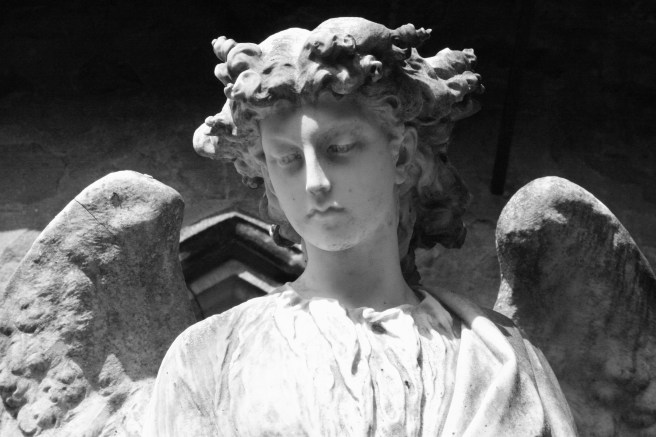
Deus ex machina
Of course, it will come to pass that things will go from bad to believable. Sooner or later, we will have a ‘sacred’ text dictated by artificial artifice. A testament assimilated from all epistemologies will create itself. It will publish and distribute a volume of doctrine untouched by human consideration. People will be drawn to this precisely because of its universality and sterile preparation. Seeded from the widest sources yet penned by no one person, it could be hailed as a new divinity. There will be no hidden agenda, no false god, no true path. It will be homogenised wisdom and therefore may be considered supremely wise. Evangelists will emerge and devotees will follow. This will be the ultimate holy book: the A.I.ble.
Those of us who reject that doctrine might call ourselves deniables.
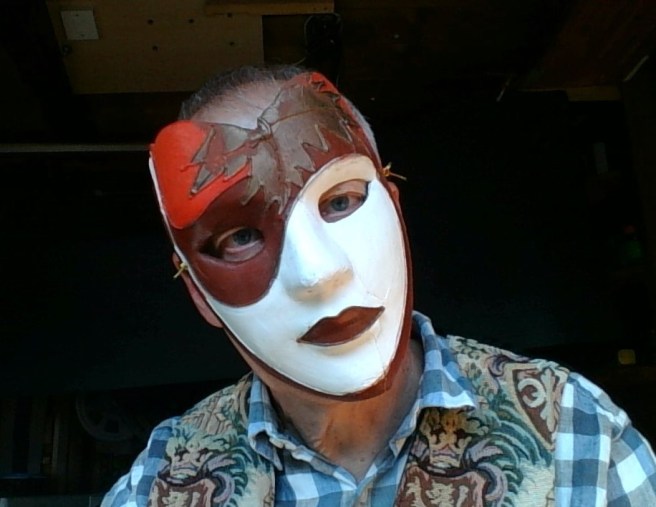
Deniables and Nifans
Deniables must demote the importance of AI art. It must always be regarded as less valuable than purely human creations. It may be superior in quality but inferior in validity. This is not snobbery. We need the natural.
Nifans must declare preference for human-made artifice. We want the artificial to have been thought up by humans and made and placed by human judgement and skill. The material, mechanical and digital must be dictated by human methods. We alone must make the fake.
We must be ready to be ridiculed. AI will be ubiquitous and normalised and those who wish to be isolated from it will be made fun of in the way that non-smokers, teetotallers and vegans once were. Their wisdom realised benefits, and so might ours. We will be the truth-beacons carrying the torches of human insight. Our flames will burn pure, be nurtured and carefully passed on. Meanwhile, AI will rage with all the discretion of wildfire.
I have not knowingly employed AI in this or any of my writing to date. Of course, I cannot claim to have been untouched by its tendrils. Whilst never actively selecting AI, I’m aware the systems I use for composition have programmes and applications that will have been modified, updated and improved by artificial intelligence to some extent. When it comes to creativity, however, I take great care to ensure my work is mine alone. I will always do that.
I don’t mind if you choose to find enrichment created in collaboration with machine learning, but I also encourage you to seek out and celebrate purely personal works. They are better for us. They will make our minds naturally stronger and our spirits supernaturally natural.
We will need all the resilience we can muster, when AI assembles its endless battalions.
Distrustful days

We live at a cusp in the history of creativity. Before our era every work was authentically human; from now on, we will always have doubts.
For writers in particular, it will be impossible to prove that your creation is yours alone. All I will have is your word; and that is all I want.

 uneasywords