Entwining fact and fiction to find a truthful way to be a hedgehog
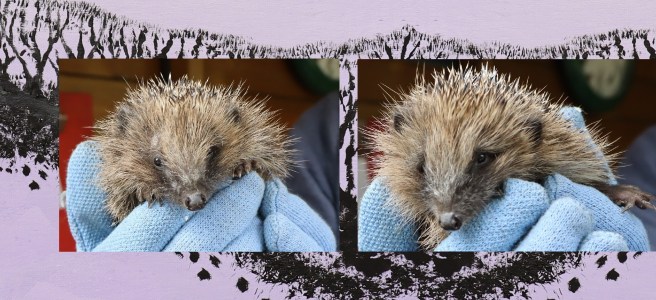
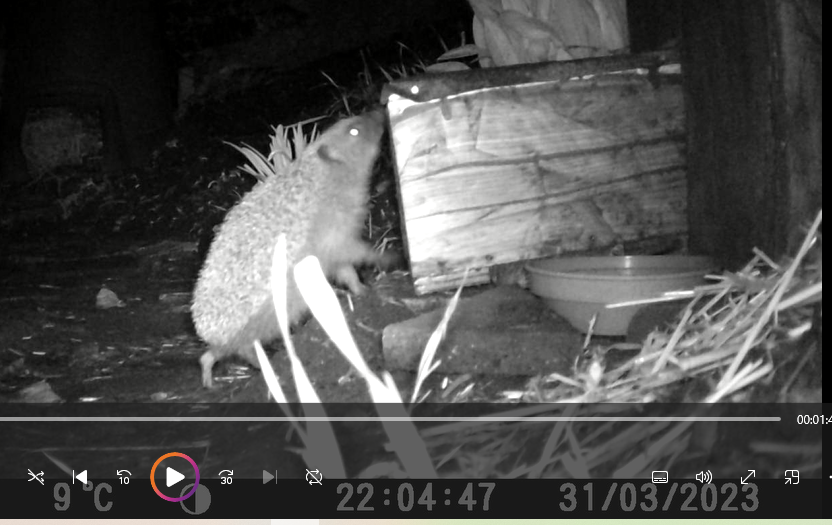
The idea for Great Hedgepectations had three origins. In the build up to last year’s launch of Fly on the Wall’s Modern Gothic anthology I was reading and re-reading a lot of classic Gothic fiction including Charles Dickens’ Great Expectations. At the same time my wife was becoming increasingly involved in fostering hedgehogs on behalf of a local rescue society. She purchased a trail camera which we used to observe wildlife in our garden as well as to sometimes monitor the nighttime routines of our temporarily captive hogs. The Dickensian fiction and the nocturnal footage became fused and the Great Hedgepectations title suddenly emerged from the mulch in my mind. The classic Gothic novel, the contemporary fascination, and the twisted title, prodded the old pen into action again.
The aim
From the outset, there was the intention to create a story that might appeal to a wide readership. This meant including younger readers. I hadn’t written anything for children since being commissioned by Preston Borough Council to write Gertie and the Guild Machine way back in 1990, but the experience of seeing that work performed time and time again in front of junior school children was invaluable. Adult audiences subtly let you know when they are bored; youthful audiences blatantly let you know when they are ENJOYING IT! Also, I’d never let go of my own childhood literary loves, frequently revisiting them and trying to understand how they led to a lifetime not only of reading, but of compulsively writing. I decided to make this book accessible for children aged 10 and above, but also enjoyable by adults.
The contraband
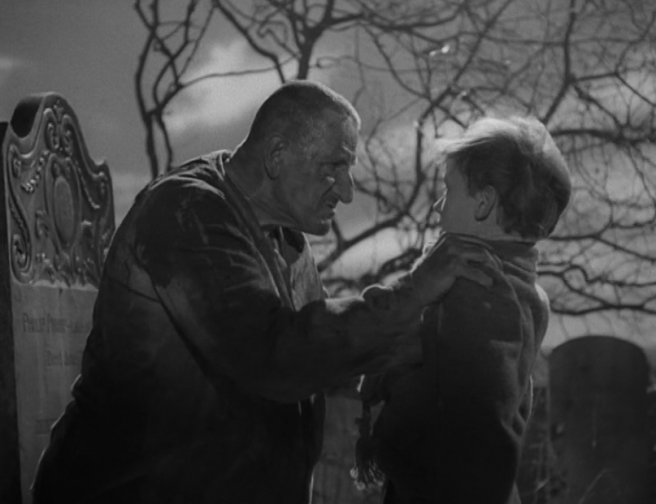
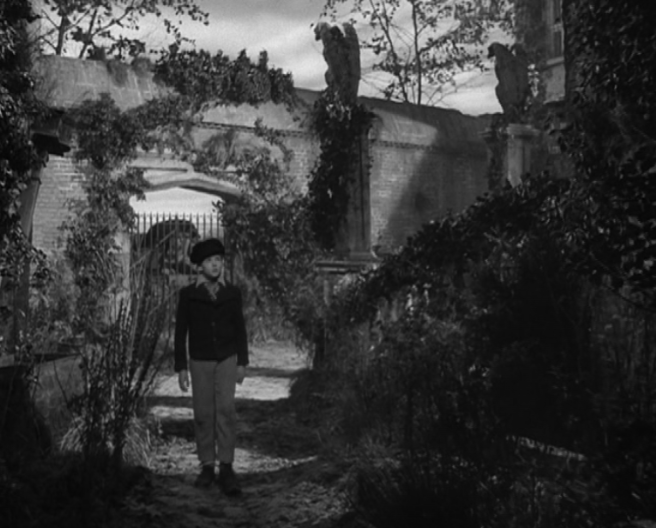
Having stolen the title, the Dicken’s tale had to be at the heart of the new story. It was a very good template. It opens with a young boy visiting a graveyard. Pip is an orphan, he is terrifyingly affronted by a thuggish escaped criminal, while he contemplates his heritage by his mother’s headstone. In Great Hedgepectations, Pip becomes Rip and the felon Magwitch becomes Grainneog, which is an old Irish word for hedgehog. There was a temptation to make the thug a badger, because badgers are one of the few natural predators of hedgehogs, but readers of Dickens will know that Magwitch plays a more complex role in the story than his initial appearance might suggest. Grainneog doesn’t quite mirror that complexity but later in the book he benefits Rip, albeit unwittingly. The unwitting aspect is crucial. It is a core component of animal interaction.

The greatest fictional prospect arising from Dickens’ novel was Miss Havisham. She was the component that settled the decision to steal the story. In the original she is a woman who has not seen the light of day since before Pip was born, and who lives in a house where the windows are curtained twenty-four hours a day. That seemed ideal for a carer of hedgehogs, who are nocturnal. Miss Havisham became Miss Herichon. Before they were known as hedgehogs, the spiky little creatures (who are not pigs at all, but closely related to shrews and moles) were known as urchins, a word that is derived from the Norman word herichon. Miss Herichon’s story is a more contemporary version of Miss Havisham’s tale.

Another key character in Great Expectations is Miss Havisham’s ward Estella. The young Estella treats Pip rebarbatively, though later in the book her attitude is more multifaceted. The corresponding role in Hedgepecations is taken by a young female called Erinacea. The Latin name for European hedgehogs is erinaceus europaeus. Gardeners may also know erinacea as a genus of dwarf spiny shrubs, sometimes called the hedgehog plant. Erinacea in our story is the bearer of amorous expectations. She is also fiercely independent as, it seems, are all female hedgehogs.
The title
Having a title from the outset is always a help. It works as a telescope, focusing the narrative and helping to obscure distractions. What are hedgepectations? Does it allude to what could be found in the undergrowth, or is it a noun for the hopes of a hedgehog? Do hedgehogs have hopes? Well, that question opened up a compost heap of worms. Hedgehogs do hope for worms, though they have higher hopes for meatier things. This book looks at expectations with the benefit of hindsight. When things happen, can we judge they are what was expected, or is it that we always have misplaced expectations? Is there any point, therefore, in having them? Perhaps we should ask a hog?
Little observations
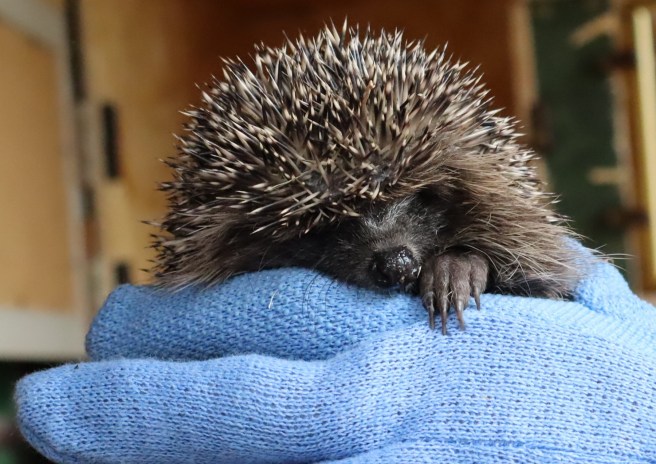
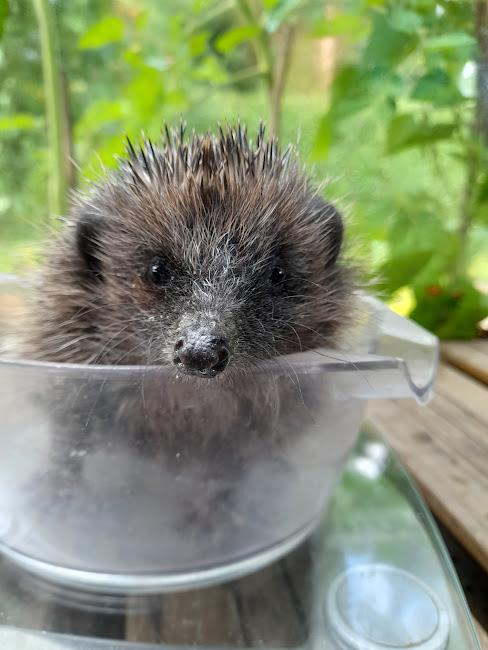
When fostering hedgehogs, it is important not to interact with them except when necessary. They are patients, not pets. Our objective is to fatten them up so that they have a better chance of surviving when they are released. Usually, they have been handed to the rescue society because they have been found in a poor state. This could be due to disease, or injury (too often caused by careless humans) or perhaps, like Pip and Rip, have been orphaned. Sometimes they have been born too late in the season to survive the cold months or are insufficiently nourished to get through hibernation. Making the hogs more familiar with the presence of humans is not conducive to their survival in the wild. Furthermore, our daytime is their sleeping time. So, we disturb them as infrequently as possible and only extract them from their nests once or twice per week to monitor their weight. If they are hibernating, we leave them be. That can be quite an anxious time. In hibernation they drop their body temperature and breathe only once per minute. Not all of them wake up again.

We have been given permission to release some hogs in our own garden when it was not known where they were found. We have been able to watch those on our trail camera as well as seeing wild visitors to our feeding station. A great deal of the hedgehog action in Great Hedgepectations is taken from these observations. The camera has a microphone so I was also able to include some of their rare vocal interactions. Monitoring the fostering cages also provided useful footage from which to describe what they do in captivity. We have viewed many hours over the years but this only provided me with a limited amount of material needed to make the story work. The rest was down to imagination, but at all times I was determined to be as truthful to the nature of hog life as possible.
The research
There are various online resources that proved useful, but of course, knowledgeable publications were invaluable. In particular The Hedgehog Book by Hugh Warwick (ISBN: 9781913134419) was most informative. Mary Swindlehurst at Leyland Hedgehog Rescue was truly the fount of our most fundamental knowledge, and via the charges she entrusted to our care, the supplier of the most vital inspiration.
Erin and Star
I could have chosen two boys as the central human characters or a boy and a girl, but if the latter, then why not two girls? A close friendship at that age seemed easier to manage if both characters were of the same gender. There are differences between the two girls and those variations come into sharper focus if there are also basic similarities. Some of the girls’ qualities centre on aspects that are evident within persons to whom I am very close. In the end though, the human story in this novel is not about being male or female, or even about being human or hedgehog. It’s about being both.

The girls’ names were chosen to resonate with other characters in the stories. Erin is the first syllable of erinacea, while Star, is the meaning of Estella. Erin’s heritage is Irish, Star’s is Caribbean.

Ultimately, I think this story asks us to think about humans and hedgehogs as fellow animals. In some biological respects, hedgehogs have more in common with humans than they do with porcupines. Hedgehogs and humans are mammals, whereas porcupines are rodents, but the story asks the reader to consider that the biological complexities of animals may not be as important as their instinctive similarities.
The plot
I never plan out a plot when working on a story. I like , as much as possible, to be on the same page as the reader. If I want to find out what happens next and at the end, then I feel the reader will have a similar experience. If I know what is coming, I tend to lose motivation. So, I let the story go where the story naturally wants to go. There will be subsequent revision, but that’s for later. Initially, I need to re-live the compulsion first felt while devouring those childhood reads. With this book, however, there were some way-markers in place. Paying homage to the Dickens work that inspired it, I decided to replicate, or reflect, parts of the plot and some of the roles of the Victorian novel, especially those mentioned above. In the end, though, I had to let this story evolve organically. The central drive was to discover why Miss Herichon lived as a hermit and, like Miss Havisham, still wore the wedding dress in which she had not been married.

What transpired made me slightly uncomfortable. Was the outcome undermining my desire to make the book suitable for older youngsters? The issues at the heart of the backstory are grown-up ones. I consulted trusted others, who thought the content beneficial for maturing minds, and I’m glad to say that readers of the book have agreed.

I do not like to issue a work that is superficial. Hedgehogs scour the surface of the earth; but sometimes they have to dig deeper.
Ideal characters
Persons who write fiction can sometimes be heard to claim that ‘the characters took over’. Whilst I understand what they mean, such a claim is nonsense. Fictional characters do not exist. They cannot take over. You can always delete their ideas, speeches and actions, or even the entire character.

Similarly, authors get asked why a character behaved in a certain way, as if the character did so because they chose to, or as a consequence of their psychology or biology or both.  This too, is nonsense. Fictional characters do not have a psychology or even a biology, unless it is specified or implied by the author or presumed by the reader, and even then, they do not have the autonomy to act on it. Fictional characters do what they do because that’s what they do. There is no other reason. Fictional characters behave in the manner depicted as a consequence of being fictional. This is why hedgehogs are ideal fictional characters.

The title telescope of this story brought into focus an immutable truth: hedgehogs do what they do because they are hedgehogs. Throughout the writing I tried to make every ‘decision’ by a hog as biologically honest as possible. What would Rip do – not because he was a character in a story – but if he really was a hedgehog? This, I hope, helps us to consider the question on the cover of the book.

Perhaps it will also prompt us to consider the expectations of other animals regardless of what species they, or we, might be.
Buckshaw Community Hedgehog Project
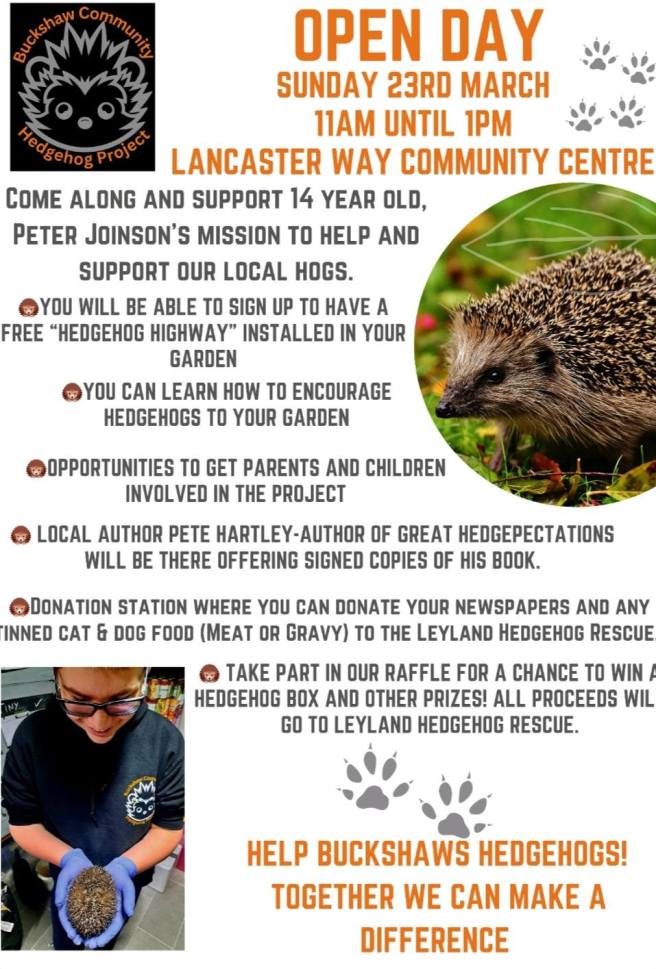
I will be supporting this marvellous initiative established by Peter and Emma Joinson. I’ll be taking along some copies of Great Hedgepectations for sale at £5. I’ll also have a smattering of my other books available. All profits on the day will go to Leyland Hedgehog Rescue, and in the case of Great Hedgepectations, the whole purchase price will be donated.

If you buy the book online, at least 40% of your payment will be donated to the rescue society.

Related posts
More about Great Expectations: Lean Expectations
You can read more about our hedgehog interactions and other natural things in the unspoken garden series of posts. The most recent example is: Swift exit
Father and son discuss flora-based and fauna-based fiction in Prognostication
Links
Buckshaw Community Hedgehog Project

 uneasywords
One thought on “A tale of two piggies”